Yellowstone (Etats Unis): Aucun risque d’éruption à court terme ! // No risk of a short-term eruption !

drapeau-francaisIl y a quelques jours (le 6 mai 2016), le tabloïd britannique Daily Express a publié un de ces articles dont le seul but est d’attirer plus de lecteurs, mais qui n’ont aucune valeur scientifique
On pouvait lire qu’ « après la série de séismes enregistrés à travers le monde, il y a de plus en plus de craintes que le volcan du Wyoming (autrement dit Yellowstone) soit sur le point d’entrer en éruption, ce qui pourrait rendre les deux tiers des Etats-Unis immédiatement inhabitables car les volumineuses émissions de cendre dans l’atmosphère bloqueraient la lumière du soleil et affecteraient directement la vie sous ce nuage de cendre. Les chasseurs d’OVNI ont mis de l’huile sur le feu en prétendant avoir vu un vaisseau spatial extraterrestre en train de planer au-dessus du volcan de Yellowstone, dans le but de le surveiller avant une puissante éruption à très court terme. »
Heureusement, cette information est totalement infondée et le dernier rapport de l’Observatoire Volcanique de Yellowstone pour le mois d’avril est loin d’être alarmant. Voici les principaux éléments du rapport:
Au cours du mois d’avril 2016, 53 séismes ont été détectés dans le parc national de Yellowstone. L’événement le plus significatif était un micro séisme de magnitude M 2.0 le 23 avril, à 6,5 km au nord du Norris Geyser Basin. En avril 2016, la sismicité a inclus un petit essaim de 11 événements le 17 avril. La secousse la plus forte, d’une magnitude de M 1,5, a eu lieu le 17 avril à 13 km à l’est de West Thumb.
En ce qui concerne la déformation du sol, un petit soulèvement du sol (environ 1 cm) a été enregistré dans la partie nord de la caldeira de Yellowstone. L’inflation semble avoir commencé au début de l’année 2016 et son évolution est semblable à  ce qui avait été observé en 2013-2014. La plupart des stations GPS à l’intérieur de la caldeira enregistrent un léger affaissement, à raison d’environ 1,5 cm par an. Globalement, la déformation actuelle à Yellowstone reste dans la norme historique.

———————————–

drapeau-anglaisA few days ago (on May 6th 2016), the British Daily Express released one of these articles whose only goal is to attract more readers and which are a nonsense from a scientific point of view

One could read that “following a spate of seismic activity around the globe, fears have been mounting the volcano in Wyoming (i.e.Yellowstone) could be about to blow which could leave two-thirds of the USA immediately uninhabitable as the large spew of ash into the atmosphere would block out sunlight and directly affecting life beneath it. UFO hunters have now added more fuel to the fire by claiming to have spotted alien spacecraft hovering over the Yellowstone volcano, claiming they are monitoring it before its imminent massive eruption.”

Fortunately, this piece of news is totally unfounded and the Yellowstone Volcano Observatory’s latest report for the month of April is by no means alarming. Here are the main parts of the report:

During April 2016, 53 earthquakes were located in the Yellowstone National Park. The largest event was a micro earthquake of magnitude M 2.0 on April 23rd and was located 6.5 km north of Norris Geyser Basin.  April 2016 seismicity included a small earthquake swarm of 11 earthquakes occurring on April 17th. The largest event, with a magnitude of M 1.5, occurred on April 17th 13 km east of West Thumb.
As far as ground deformation is concerned, a small amount of ground uplift (about 1 cm) has been recorded to the north of the Yellowstone Caldera. The uplift appears to have started early in 2016 and the apparent pattern is similar to that observed in 2013/2014. Most of the GPS stations within the caldera record slight subsidence, at a rate of about 1.5 cm/year. Current deformation patterns at Yellowstone remain within historical norms.
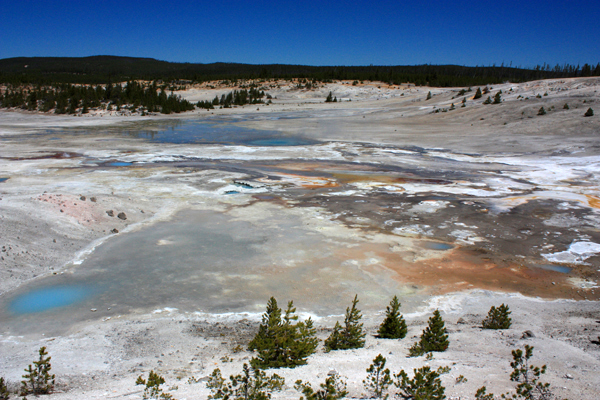
Norris-Geyser-Basin

West Thumb blog

Vue des champs hydrothermaux de Norris et West Thumb.

(Photos: C. Grandpey

La déformation de l’Etna // Mount Etna’s deformation

drapeau francaisL’INGV a mis en ligne une animation qui montre la déformation de l’Etna entre février 2015 et février 2016. Les mesures ont été effectuées à l’aide des techniques interférométriques utilisant des données TOPSAR (Terrain Observation with Progressive Scans SAR) acquises par le satellite Sentinel-1A. Ce satellite, conçu par l’Agence Spatiale Européenne (ESA), est équipé d’un capteur SAR en bande C, et est capable de mesurer les déformations du sol avec une précision subcentimétrique.
Les données satellitaires ont été traitées en utilisant l’approche SBAS (Small Baseline Subset), qui permet l’analyse temporelle des déformations en utilisant l’ensemble des données d’images radar obtenues par le capteur dans la gamme choisie. Ce processus permet d’obtenir les vitesses moyennes de déformation en ligne de vue, ainsi que la série temporelle de déformations estimée à partir de chaque pixel de l’image.
Au cours de la période couverte par les observations, on remarque (A) l’inflation (en bleu) de l’ensemble de l’édifice volcanique jusqu’en novembre 2015 (avant les violents épisodes paroxystiques de décembre 2015); (B) la déflation qui a accompagné l’activité éruptive et a presque complètement effacé l’inflation précédente; (C), la poussée exercée sur versant nord-est du volcan (en rouge), pendant et après la séquence éruptive; (D), le mouvement de l’ensemble du versant oriental, avec une grande déformation de toute la partie à l’est des Timpe; (E) la propagation vers le sud de la déformation du flanc est, avec l’activation de la faille de San Gregorio-Acitrezza dans la seconde moitié de Janvier 2016. Les lignes noires représentent les failles répertoriées.

Vous verrez l’animation en cliquant sur ce lien :

http://www.ct.ingv.it/images/Sentinel/Sentinel_asce_2015_2016_low.GIF

————————————–

drapeau anglaisINGV has posted an animation that shows the deformation undergone by Mount Etna between February 2015 and February 2016. The measurements were performed with the help of interferometric techniques using TOPSAR data (Land Observation with Progressive Scans SAR) acquired by Sentinel-1A satellite. The satellite, developed by the European Space Agency (ESA), is equipped with a SAR sensor in C-band and is capable of measuring ground deformation with sub-centimeter accuracy.
The satellite data were processed using the SBAS approach (Small Baseline Subset), which allows the temporal deformation analysis using all radar image data obtained by the sensor in the selected range. This process allows to obtain the average speeds of deformation in line of sight, and the estimated time series of deformations from each pixel of the image.
During the period covered by the observations, we note (A) inflation (in blue) of the entire volcanic edifice until November 2015 (before the violent paroxysmal episodes in December 2015); (B) the deflation that accompanied the eruptive activity and almost completely erased the previous inflation; (C), the thrust on the northeastern slope of the volcano (in red), during and after the eruptive sequence; (D), the movement of the entire eastern slope, with a large deformation of the whole part of east Timpe; (E) spread to the southern flank of the deformation, with the activation of the San Gregorio-Acitrezza fault in the second half of January 2016. The black lines represent the listed faults.

You will see the animation by clicking on this link:

http://www.ct.ingv.it/images/Sentinel/Sentinel_asce_2015_2016_low.GIF

Etna deformation

Source: INGV / ESA

Piton de la Fournaise (Ile de la Réunion): Reprise de l’inflation // The volcano is inflating again

drapeau-francaisLe dernier bulletin de l’OVPF en date du 10 février 2016 donne les dernières nouvelles du Piton de la Fournaise.
S’agissant de la sismicité, elle est restée élevée jusqu’à la mi-novembre 2015, avant de décroître et d’atteindre son niveau faible actuel.

Piton sismicité

S’agissant de la déformation de l’édifice, une reprise de l’inflation a été observée après la dernière éruption, suivie d’un ralentissement significatif en décembre. Toutefois, l’Observatoire fait remarquer que depuis le 24 janvier 2016, les réseaux GPS enregistrent de nouveau une accélération de l’inflation, avec jusqu’à 1cm de dilatation de la zone sommitale en 15 jours. La source de cette inflation est localisée à 1500-2000 m sous le cratère Dolomieu. Les taux d’inflation sont comparables à ceux observés avant les éruptions de juillet et août 2015.
S’agissant des gaz, le réseau géochimique enregistre depuis fin janvier 2016 une hausse modérée du flux de CO2 par le sol au niveau des stations distales et une augmentation des émissions soufrées (SO2 et H2S) ainsi que de CO2 au niveau des fumerolles sommitales.

—————————–

drapeau anglaisYesterday’s update released by OVPF (February 10th 2016) gives the latest news of the Piton de la Fournaise.
Seismicity remained fairly high until mid-November 2015, before decreasing and reaching its current low level.
Regarding the deformation of the edifice, a new increase in inflation was observed after the last eruption, followed by a significant slowdown in December. However, the Observatory notes that since 24 January 2016, the GPS systems has recorded a new acceleration of inflation, with up to 1cm expansion of the summit area in 15 days. The source of that inflation is located at 1500-2000 metres beneath the Dolomieu Crater. Inflation rates are comparable to those observed before the eruptions of July and August 2015.
Concerning the gases, since the end of January 2016 the geochemical network has recorded a moderate increase in the CO2 flow through the soil at the distal stations and increased sulfur (SO2 and H2S) and CO2 emissions at the summit fumaroles.

Piton Fournaise

Crédit photo: Wikipedia

L’activité dans le Parc de Yellowstone en octobre 2015 // Activity in Yellowstone National Park in October 2015

drapeau francaisL’activité à Yellowstone est faible à l’heure actuelle. La sismicité et la déformation du sol sont à des niveaux normaux.
L’Observatoire indique que pendant le mois d’octobre 2015 les stations sismiques ont enregistré 83 séismes localisés dans le Parc National de Yellowstone. L’événement le plus significatif a été un petit séisme de M 2.4 le 13 octobre à 06h23, à environ 13 km à l’ouest du Vieux Fidèle.
La sismicité en octobre 2015 a également inclus un petit essaim de 23 événements les 13 et 14 de ce mois à 14 km au NNO de West Yellowstone (Montana).
L’activité sismique à Yellowstone en octobre est restée globalement à des niveaux relativement faibles.

Les stations GPS de Yellowstone continuent à révéler peu ou pas de mouvement de terrain.

Vous trouverez plus d’informations sur l’activité hydrothermale dans le Parc en visitant le site de l’Observatoire:
http://volcanoes.usgs.gov/observatories/yvo/index.html
En cliquant sur la section «Monitoring», vous aurez accès à des données de surveillance d’un grand nombre de sources géothermales dont le Norris Geyser Basin, l’un des points les plus chauds du Parc.

—————————————–

drapeau-anglaisActivity at Yellowstone is low at the moment. Seismicity and ground deformation are both at normal levels.
The Observatory indicates that during October 2015, the seismic stations reported 83 earthquakes were located in the Yellowstone National Park region. The largest event was a small M 2.4 earthquake on October 13th at 06:23 a.m., located about 13 km west of Old Faithful.
October 2015 seismicity also included a small earthquake swarm with 23 events on October 13th and 14th located 14 km NNW of West Yellowstone (Montana).
Yellowstone earthquake activity in October globally remains at low background levels.

GPS stations in Yellowstone continue to show little or no ground movement.

You will find more information about hydrothermal activity in the Park by visiting the Observatory’s website:
http://volcanoes.usgs.gov/observatories/yvo/index.html
By clicking on the “Monitoring” section, you will have access to the monitoring data of a great number of geothermal features like the Norris Geyser Basin, one of the hottest places in the Park.

Norris

Vue du Norris Geyser Basin (Photo: C. Grandpey)