Vers une perturbation de la circulation thermohaline ? // Toward a disruption of the AMOC ?

Bien que complexe, la circulation thermohaline, autrement dit le mécanisme qui gère les courants marins, est essentielle à la vie sur notre planète. Ce sont en grande partie les courants marins qui, par leur influence, gèrent le climat des zones où nous vivons. Il ne faudrait pas oublier que les océans couvrent 71 % de la surface du globe. Il s‘ensuit qu’une modification de la circulation océanique aura forcément des conséquences sur toute la planète et particulièrement dans l’Atlantique Nord, là où les courants marins prennent naissance.

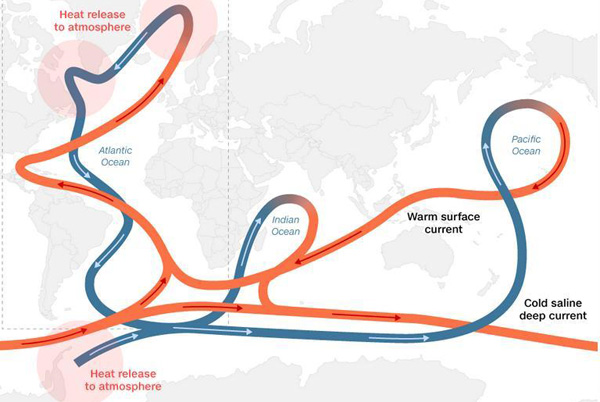
Ainsi, le Gulf Stream prend naissance dans le Golfe du Mexique pour ensuite se diriger vers l’Angleterre. On lui attribue les hivers peu rigoureux en Europe, contrairement à ceux que subit l’Amérique du Nord. Peu de gens savent que l’arrivée du Gulf Stream près des côtes occidentales de l’Europe constitue le point de départ des grands courants qui sillonnent la planète. Lorsque le Gulf Stream passe entre la Scandinavie et le Groenland, il côtoie les eaux froides de l’Arctique et se refroidit considérablement, au point que la mer se recouvre de glace.

L’eau sous forme de glace n’a pas la capacité de contenir du sel. En passant au stade de glace, cette eau rejette le sel qu’elle contenait. On se retrouve donc en présence d’une eau froide qui contient plus de sel que les eaux avoisinantes. Comme c’est le cas dans l’atmosphère où l’air chaud monte et l’air froid descend, dans l’océan l’eau chaude reste à la surface et l’eau froide coule vers le fond. De plus, cette eau contient beaucoup plus de sel et est donc plus dense. La conséquence est que son mouvement vers le fond est accéléré.

Cette eau froide et très salée longe la dorsale atlantique jusqu’au sud des Amériques avant de glisser vers l’Océan Pacifique, où elle se réchauffera et remonte donc plus près de la surface avant de continuer sa course vers son point de départ. On se rend compte que cette circulation thermohaline est due aux différences de températures et de salinité des eaux du globe.

Les océanographes ont remarqué depuis quelques années que la circulation thermohaline s’est modifiée dans l’Arctique. Cela a commencé avec les premières observations du ralentissement du courant-jet polaire dans les années 1990. La chose inquiétante, c’est que ce ralentissement est devenu la norme depuis 2005 et qu’il est directement lié au réchauffement de l’Arctique. Ce réchauffement est responsable de la disparition de la vieille glace au profit d’une glace plus jeune et moins épaisse.

La disparition de la glace de mer en Arctique est une catastrophe par son effet sur l’albédo. En effet, les rayons du soleil ne sont plus réfléchis vers l’espace, et ils sont au contraire absorbés par l’océan. Les scientifiques ont mesuré une température de l’eau atteignant par endroits 11°C en été, ce qui est tout à fait anormal et correspond aux observations climatiques qui montrent que l’Arctique se réchauffe deux fois plus vite que le reste de la planète. De ce fait, les secteurs les moins profonds, comme le bord des côtes vont perdre leur pergélisol et libérer de grandes quantités de méthane. Comme je l’ai écrit à plusieurs reprises, le méthane (CH4) est un gaz à effet de serre 28 fois plus puissant que le CO2, même si sa durée de vie est plus brève. Néanmoins, le méthane peut faire grimper la température globale de 0,6°C.

Comme les eaux de l’Arctique se réchauffent, le point de départ de la circulation thermohaline s’est également réchauffé. On a longtemps cru que si l’Arctique fondait, l’apport d’eau froide et non salée dans l’Atlantique Nord ralentirait le Gulf Stream avec des hivers beaucoup plus rigoureux en Europe. La vérité, c’est que le réchauffement de la planète est arrivé à un tel point que toutes les régions vont se réchauffer. Les côtes occidentales de l’Europe, qui bénéficient de l’influence du Gulf Stream, vont se réchauffer moins vite à cause de l’apport d’eau froide dans l’Atlantique Nord, mais elles vont se réchauffer quand même.

Dans la mesure où le Gulf Stream évacue naturellement la chaleur accumulée aux tropiques vers le pôle et que ce courant sera ralenti par la fonte de l’Arctique, la chaleur va s’accumuler plus vite dans l’Atlantique au niveau des tropiques, ce qui risque fort de favoriser le développement d’ouragans majeurs. Si l’on associe un courant chaud qui amorce plus difficilement la circulation thermohaline d’une part, et la plus grande facilité à accumuler de la chaleur dans la zone de formation des cyclones tropicaux atlantiques d’autre part, on arrive à une situation qui met en danger des centaines de millions de personnes.

Source : Météo Media.

——————————————–

Although complex, the thermohaline circulation – or AMOC (Atlantic Meridional Overturning Circulation) – is the mechanism that manages ocean currents, and that is essential to life on our planet. It is largely the ocean currents that, through their influence, manage the climate of the regions where we live. It should not be forgotten that the oceans cover 71% of the Earth’s surface. It follows that a change in ocean circulation will inevitably have consequences on the whole planet and particularly in the North Atlantic, where sea currents originate.
Thus, the Gulf Stream originates in the Gulf of Mexico and then moves towards England. It is rhe cause of mild winters in Europe, unlike those in North America. Few people know that the arrival of the Gulf Stream near the western coasts of Europe is the starting point for the great currents that crisscross the planet. When the Gulf Stream passes between Scandinavia and Greenland, it coasts with the cold Arctic waters and cools considerably, to the point that the sea becomes covered with ice.
Water in the form of ice does not have the capacity to contain salt. Passing the ice stage, this water rejects the salt it contained. We therefore find ourselves in the presence of cold water which contains more salt than the surrounding waters. As is the case in the atmosphere where warm air rises and cold air sinks, in the ocean warm water stays on the surface and cold water sinks to the bottom. In addition, this water contains much more salt and is therefore more dense. The consequence is that its movement towards the bottom is accelerated.
This cold and very salty water runs along the Atlantic ridge to the southern Americas before sliding towards the Pacific Ocean, where it will warm up and therefore rise closer to the surface before continuing its course towards its starting point. We realize that this thermohaline circulation is due to the differences in temperature and salinity of the world’s waters.
Oceanographers have noticed in recent years that thermohaline circulation has changed in the Arctic. It started with the first observations of the polar jet slowdown in the 1990s. The worrying thing is that this slowdown has become the norm since 2005 and is directly linked to the warming of the Arctic. This warming is responsible for the disappearance of old ice in favour of younger, thinner ice.
The disappearance of sea ice in the Arctic is a disaster because of its effect on the albedo. Indeed, the sun’s rays are no longer reflected back to space, and are instead absorbed by the ocean. Scientists have measured a water temperature in places as high as 11°C in summer, which is completely anomalous and corresponds to climatic observations which show that the Arctic is warming twice as fast as the rest of the planet. As a result, the shallower areas, such as the coastline, will lose their permafrost and release large amounts of methane. As I have written several times, methane (CH4) is a greenhouse gas 28 times more powerful than CO2, even if its lifespan is shorter. However, methane can cause the global temperature to rise 0.6°C.
As the Arctic waters warm, the starting point of the thermohaline circulation has also warmed. It has long been believed that if the Arctic melted, the flow of cold, unsalted water to the North Atlantic would slow the Gulf Stream with much harsher winters in Europe. The truth is, global warming has come to such an extent that all regions are going to get warmer. The western coasts of Europe, which benefit from the influence of the Gulf Stream, will warm up less quickly due to the cold water coming into the North Atlantic, but they will warm anyway.
Insofar as the Gulf Stream naturally evacuates the heat accumulated in the tropics towards the pole and that this current will be slowed down by the melting of the Arctic, the heat will accumulate more quickly in the Atlantic at the level of the tropics, with a strong risk of favouring the development of major hurricanes. If we associate a hot current which is more difficult to initiate the thermohaline circulation on the one hand, and the greater facility to accumulate heat in the zone of formation of Atlantic tropical cyclones on the other hand, we arrive at a situation which puts hundreds of millions of people at risk.
Source: Météo Media.

Schéma montrant la circulation thermohaline [Source :Groupe d’experts intergouvernemental sur l’évolution du climat (GIEC)]

Circulation océanique et climat (2ème partie) // Ocean circulation and climate (Part 2)

Il est difficile de déterminer ce que les schémas évoqués dans la première partie de cet article  pourraient signifier pour l’avenir de la Terre. Des preuves récentes suggèrent que l’AMOC a commencé à s’affaiblir à nouveau il y a 150 ans. Cependant, les conditions actuelles sont assez différentes de celles d’il y a 13000 ans. La température globale était beaucoup plus basse à l’époque, la banquise d’hiver s’étendait au sud de New York et la structure de l’océan était bien différente. En outre, l’affaiblissement passé de l’AMOC fut bien plus important que la tendance actuelle.

Selon un rapport du GIEC, il y a de fortes chances pour que l’AMOC ralentisse au cours du 21ème siècle, mais le phénomène serait très progressif. Un arrêt complet, qui entraînerait une chute rapide de la température de l’Atlantique du Nord, n’aurait que de très faibles chances de se produire au cours du siècle en cours.

Les observations récentes du climat montrent que quelque chose se passe déjà dans l’Atlantique Nord. La région subpolaire au sud de la Groenland, y compris la Mer du Labrador, est quasiment la seule du monde à ne pas s’être réchauffée depuis le début du 20ème siècle. Ce serait l’une des manifestations de l’affaiblissement de l’AMOC, selon une étude parue fin mars 2015, signée par des chercheurs du Potsdam Institute for Climate Research. Les scientifiques estimaient alors que le réchauffement climatique global dû aux émissions humaines de gaz à effet de serre avait déjà commencé à ralentir sérieusement la circulation thermohaline.

D’après un article publié en avril 2018 dans la revue Nature,  le système de circulation de l’Atlantique Nord est dans un état de fragilité sans précédent depuis 1 600 ans. Des questions subsistent quant à la date exacte du début du déclin. Les chercheurs ont découvert que la force de l’AMOC fut relativement stable de 400 à 1850 environ, puis s’est affaiblie au début de l’ère industrielle. Cette transition coïncide avec la fin du petit âge glaciaire qui a touché de nombreuses régions du globe. Les auteurs de l’article estiment que la force de l’AMOC a diminué d’environ 15% pendant la période industrielle, par rapport à son flux des 1 500 dernières années.

L’énigme de l’impact de la circulation océanique sur les températures globales n’est probablement pas résolue. Il n’est en effet pas si certain qu’un ralentissement de l’AMOC favorise dans les prochaines décennies une baisse des températures en Europe, dans un contexte de réchauffement climatique lié aux émissions anthropiques de gaz à effet de serre. En 2018, une autre étude publiée dans Nature a montré que l’AMOC, dans une phase «faible» entre 1975 et 1998, n’avait pas empêché les températures de surface d’augmenter rapidement au cours de la période.

Le réchauffement provoqué par l’homme a-t-il modifié le rôle principal de l’AMOC ? Au lieu de déplacer la chaleur vers le nord, a-t-il désormais pour effet principal de stocker la chaleur dans les profondeurs de l’Atlantique ?

Des analyses du bilan en eau douce basées sur des observations effectuées en 2017 suggèrent que l’AMOC se trouve dans un régime instable susceptible de subir de grands changements.  Cette dernière étude estimait que l’AMOC serait susceptible de s’effondrer 300 ans après un doublement de la concentration de CO2 dans l’atmosphère par rapport au niveau de 1990. L’effondrement de l’AMOC entraînerait d’importantes réactions climatiques : un refroidissement important sur le nord de l’Atlantique Nord et les zones voisines, la glace de mer augmenterait sur les mers Groenland-Islande-Norvège et au sud du Groenland.

Source : global-climat.

   —————————————————–

It is difficult to determine what the patterns mentioned in the first part of this post could mean for the future of the Earth. Recent evidence suggests that AMOC began to weaken again 150 years ago. However, the current conditions are quite different from those of 13,000 years ago. The global temperature was much lower at the time, the winter ice sheet extended south of New York and the ocean structure was quite different. In addition, the past weakening of AMOC was much larger than the current trend. According to an IPCC report, there is a good chance that AMOC will slow down in the 21st century, but the phenomenon would be very gradual. A complete halt, which would bring about a rapid fall in the temperature of the North Atlantic, is unlikely to occur during the current century.
Recent observations of the climate show that something is already happening in the North Atlantic. The subpolar region of southern Greenland, including the Labrador Sea, is virtually the only one in the world that has not warmed since the beginning of the 20th century. This might be one of the signs of the weakening of AMOC, according to a study published late March 2015, by researchers at the Potsdam Institute for Climate Research. Scientists then estimated that global warming due to human emissions of greenhouse gases had already begun to seriously slow down the thermohaline circulation.
According to an article published in April 2018 in the journal Nature, the circulation system of the North Atlantic is in a state of fragility unprecedented for 1,600 years. Questions remain as to the exact date of the onset of decline. The researchers found that the strength of AMOC was relatively stable from about 400 to 1850, then weakened in the early days of the industrial age. This transition coincides with the end of the Little Ice Age that affected many parts of the globe. The authors of the article estimate that the strength of AMOC has decreased by about 15% during the industrial period, compared to its flow of the last 1500 years.
The enigma of the impact of ocean circulation on global temperatures is probably not resolved. Indeed, it is not so certain that a slowdown in AMOC will, in the coming decades, favour a drop in temperatures in Europe, in the context of global warming linked to anthropogenic greenhouse gas emissions. In 2018, another study published in Nature showed that AMOC, in a « weak » phase between 1975 and 1998, had not prevented surface temperatures from rising rapidly during the period.
Has man-made warming changed the main role of AMOC? Instead of moving the heat northward, does it now have the main effect of storing heat in the depths of the Atlantic?
Freshwater balance analyses based on observations made in 2017 suggest that AMOC is in an unstable regime that is likely to undergo major changes. The latest study estimated that AMOC is likely to collapse 300 years after a doubling of the CO2 concentration in the atmosphere compared to the 1990 level. The collapse of AMOC would lead to major climate reactions: cooling in the North Atlantic and surrounding areas, sea ice would increase in the Greenland-Iceland-Norway seas and in southern Greenland.
Source: global-climat.

Schéma montrant la circulation thermohaline [Source : GIEC]

Circulation océanique et climat (1ère partie) // Ocean circulation and climate (Part 1)

Aujourd’hui avec le réchauffement climatique, la crainte n’est plus que le ciel nous tombe sur la tête, mais que la circulation des courants océaniques se modifie, avec de sévères conséquences sur le climat de notre planète. Au cours de mes conférences, j’entends souvent des questions sur cette éventualité.

Ce ne serait pas la première fois que la circulation océanique subirait des modifications. Une nouvelle étude nous donne des précisions intéressantes quand au timing de l’évolution passée de la « circulation océanique méridienne de retournement atlantique », autrement connue sous le nom d’AMOC (Atlantic meridional overturning circulation). Dans l’Océan Atlantique, ce tapis roulant géant transporte les eaux chaudes des tropiques vers l’Atlantique Nord, où elles refroidissent et coulent puis retournent vers le sud dans les profondeurs de l’océan. L’AMOC est ainsi un acteur important du climat mondial, régulant les régimes climatiques dans l’Arctique, en Europe et dans le monde.

A plusieurs reprises, depuis la fin de la dernière glaciation, il y a 20 000 ans, l’AMOC s’est déjà effondré de façon brutale, ramenant le climat à des conditions glaciaires en Europe.

Des indices d’un ralentissement du système sont de plus en plus nombreux et certains scientifiques craignent qu’il puisse avoir des effets majeurs, tels que la baisse des températures en Europe et le réchauffement des eaux au large de la côte est des Etats-Unis, pouvant potentiellement nuire à la pêche et exacerber les ouragans.

Selon les prévisions, le réchauffement de la planète devrait affaiblir l’AMOC mais l’ampleur du changement reste incertaine. La plupart des modèles climatiques prévoient un ralentissement modéré mais pas un arrêt complet de l’AMOC.

Une nouvelle étude publiée dans Nature Communications donne des indications sur la rapidité avec laquelle ces changements ont pu intervenir dans le passé. Une équipe scientifique de l’Observatoire de la Terre Lamont-Doherty de Columbia s’est concentrée sur une zone où l’eau coule de la surface vers le fond de l’Atlantique Nord. D’après les chercheurs, l’AMOC a commencé à s’affaiblir environ 400 ans avant la vague de froid majeure survenue il y a 13 000 ans. Puis l’AMOC a commencé à se renforcer environ 400 ans avant le réchauffement brutal qui s’est produit il y a 11 000 ans. Pour déterminer si les changements passés du transport océanique se produisaient avant ou après les changements brusques de climat qui ont ponctué la dernière déglaciation dans l’hémisphère nord, l’équipe scientifique a rassemblé les données tirées de sédiments au fond de la mer de Norvège, de sédiments lacustres du sud de la Scandinavie et de carottes de glace du Groenland. Les anciennes couches du lac contiennent des plantes en décomposition qui extraient le carbone 14 directement de l’atmosphère, ce qui permet de déterminer l’âge de chaque couche de sédiment du lac. Les auteurs de l’étude ont ensuite fait correspondre les couches de sédiments lacustres aux couches de sédiments marins. Cela a permis de révéler la rapidité avec laquelle l’eau coulait dans cette zone, et donc le processus appelé « formation d’eau profonde » qui est essentiel pour maintenir la circulation de l’AMOC. Pour parachever l’étude, il a fallu analyser les carottes de glace du Groenland et étudier les changements de température et de climat au cours de la même période. C’est ainsi que les chercheurs ont pu mettre en parallèle les changements de la circulation océanique et les changements climatiques.

La comparaison des données des échantillons a révélé que l’AMOC s’est affaibli dans la période qui a précédé la dernière vague de froid majeure de la planète il y a environ 13 000 ans. La circulation océanique a commencé à ralentir environ 400 ans avant la vague de froid, mais une fois que le climat a commencé à changer, les températures au Groenland ont rapidement chuté de 6 degrés environ.

Un schéma similaire est apparu vers la fin de cette vague de froid. Le courant a commencé à se renforcer environ 400 ans avant que l’atmosphère ne commence à se réchauffer de façon spectaculaire, sortant de l’ère glaciaire. Une fois que la déglaciation a commencé, le Groenland s’est réchauffé rapidement : sa température moyenne a augmenté d’environ 8 degrés en l’espace de quelques décennies, ce qui a provoqué la fonte des glaciers et la fonte des glaces de mer dans l’Atlantique Nord.

Source : global-climat.

———————————————

Today with global warming, the fear is no longer that the sky may fall on our heads, but that the circulation of ocean currents might change, with severe consequences on the climate of our planet. During my conferences, I often hear questions about this possibility.
This would not be the first time that ocean circulation would undergo modifications. A new study gives us interesting insights as to the timing of the past evolution of AMOC (Atlantic meridional overturning circulation). In the Atlantic Ocean, this giant conveyor transports the warm waters of the tropics to the North Atlantic, where they cool and sink and then return south into the depths of the ocean. AMOC is thus an important player in the global climate, regulating weather patterns in the Arctic, Europe and the world.
On several occasions, since the end of the last glaciation 20,000 years ago, AMOC has already collapsed abruptly, bringing the climate back to glacial conditions in Europe.
There is growing evidence of a slowing down of the system and some scientists fear that it may have major effects, such as lower temperatures in Europe and warmer waters off the east coast of the United States, potentially harmful to fishing and exacerbating hurricanes.
Global warming is predicted to weaken AMOC, but the extent of change remains uncertain. Most climate models predict a moderate slowdown but not a complete shutdown of AMOC.
A new study published in Nature Communications provides insight into how quickly these changes may have occurred in the past. A scientific team from the Lamont-Doherty Earth Observatory in Columbia has focused on an area where water is flowing from the surface to the bottom of the North Atlantic. According to the researchers, AMOC began to weaken about 400 years before the major cold wave of 13,000 years ago. Then AMOC began to strengthen about 400 years before the brutal warming that occurred 11,000 years ago. To determine whether past changes in ocean transport occurred before or after the sudden changes in climate that punctuated the last deglaciation in the northern hemisphere, the scientific team collected sediment data from the bottom of the Norwegian Sea, lake sediments from southern Scandinavia and ice cores from Greenland. The former layers of the lake contain decaying plants that extract Carbon 14 directly from the atmosphere, allowing the age of each lake sediment layer to be determined. The authors of the study then matched lake sediment layers to marine sediment layers. This revealed the speed with which water was flowing into this area, and thus the process called « deep water formation » which is essential to maintain the circulation of AMOC. To complete the study, it was necessary to analyze the ice cores of Greenland and study the changes in temperature and climate during the same period. As a result, researchers have been able to compare changes in ocean circulation with climate change.
The comparison of the sample data revealed that AMOC weakened in the period before the last major cold wave of the planet about 13,000 years ago. Ocean circulation began to slow down about 400 years before the cold wave, but once the climate began to change, temperatures in Greenland quickly dropped by about 6 degrees.
A similar pattern appeared towards the end of this cold snap. The current began to strengthen about 400 years before the atmosphere began to warm up dramatically, coming out of the ice age. Once the deglaciation began, Greenland warmed rapidly: its average temperature increased by about 8 degrees within a few decades, which caused the melting of glaciers and the melting of sea ice in the North Atlantic.
Source: global-climat.

Schéma montrant la circulation thermohaline [Source : GIEC]

Réchauffement climatique, fonte des calottes glaciaires et effets sur les courants océaniques // Global warming, melting ice caps and effects on ocean currents

Avec la fonte des calottes glaciaires arctique et antarctique, on sait d’ores et déjà que des milliards de tonnes d’eau douce vont se déverser dans l’océan. On sait aussi que ce phénomène va avoir un double effet dévastateur. D’une part, on va assister à une rapide hausse du niveau des océans. D’autre part, cette arrivée d’eau douce et très froide risque fort d’entraîner un dérèglement des grands courants océaniques, donc du climat du globe, avec des effets catastrophiques faciles à imaginer.

Une étude internationale qui vient d’être publiée début février 2019 dans la revue Nature prévient que la fonte des calottes glaciaires du Groenland et de l’Antarctique, en plus d’augmenter le niveau des océans, va aussi multiplier les événements météo extrêmes et déstabiliser le climat de certaines régions dans les prochaines décennies. On peut lire que les milliards de tonnes d’eau issues de la fonte des glaces, en particulier au Groenland, vont affaiblir les courants océaniques qui aujourd’hui transportent l’eau froide vers le sud en plongeant vers le fond de l’Atlantique, tout en repoussant les eaux tropicales vers le nord plus près de la surface. Ce phénomène est connu sous l’appellation anglaise Atlantic Meridional Overturning Circulation (AMOC) – circulation méridienne de retournement de l’Atlantique, ou circulation thermohaline. C’est une espèce de grand tapis roulant océanique qui joue un rôle crucial dans le système climatique et aide à maintenir une certaine chaleur sur l’hémisphère nord.

Selon les modèles établis par des chercheurs néo-zélandais dans le cadre de l’étude, la fonte des banquises va provoquer des perturbations importantes dans les courants océaniques et changer les niveaux de réchauffement à travers le globe.

Jusqu’à présent, de nombreuses études sur les calottes glaciaires se sont concentrées sur la vitesse de leur fonte sous l’effet du réchauffement, et sur leur point de basculement (« tipping point ») autrement dit le niveau de hausse de température à partir duquel leur disparition sera inévitable, même si la fonte totale pourrait prendre des siècles.

Les changements à grande échelle observés par les scientifiques dans leurs simulations révèlent que le climat sera plus chaotique dans les prochaines années, avec des événements météo extrêmes plus nombreux, des canicules plus fréquentes et plus intenses.

Selon des chercheurs californiens, d’ici le milieu du 21ème siècle, l’eau de fonte de la calotte du Groenland perturbera sensiblement l’AMOC, qui montre déjà des signes de ralentissement. L’échéance serait beaucoup plus courte que prévu. Les conclusions des chercheurs s’appuient sur des simulations détaillées et des observations satellitaires des changements des calottes depuis 2010. Parmi les conséquences probables de l’affaiblissement de l’AMOC, la température de l’air sera plus élevée dans le haut Arctique, l’est du Canada et l’Amérique centrale, et au contraire plus basse sur l’Europe de l’Ouest.

Source : Presse scientifique.

——————————————————–

With the melting of the Arctic and Antarctic ice sheets, we know that billions of tons of fresh water will flow into the ocean. We also know that this phenomenon will have a double devastating effect. On the one hand, we will witness a rapid rise in the level of the oceans. On the other hand, this arrival of fresh and very cold water is likely to cause a disruption of major ocean currents, and therefore of the global climate, with disastrous effects easy to imagine.
An international study just published early February 2019 in the journal Nature warns that the melting of the icecaps of Greenland and Antarctica, in addition to increasing the level of the oceans, will also multiply extreme weather events and destabilize the climate of certain regions in the coming decades. One can read that the billions of tons of water from melting ice, especially in Greenland, will weaken the ocean currents that today carry cold water to the south by diving towards the bottom of the Atlantic, while pushing tropical waters further north closer to the surface. This phenomenon is known as the Atlantic Meridional Overturning Circulation (AMOC). It is a sort of large oceanic treadmill that plays a crucial role in the climate system and helps maintain some warmth in the northern hemisphere.
According to models developed by New Zealand researchers who took part in the study, melting sea ice will cause major disturbances in ocean currents and change warming levels across the globe.
So far, many studies on ice caps have focused on the speed of their melting under the effect of warming, and on their tipping point, in other words the level of temperature rise from which their disappearance will be inevitable, even if total melting could take centuries.
The large-scale changes observed by scientists in their simulations reveal that the climate will be more chaotic in the coming years, with more extreme weather events, more frequent and more intense heat waves.
According to California researchers, by the middle of the 21st century, meltwater from the Greenland ice cap will significantly disrupt AMOC, which is already showing signs of slowing down. The deadline is thought to be much shorter than expected. The researchers’ conclusions are based on detailed simulations and satellite observations of ice sheet changes since 2010. Among the likely consequences of the weakening of AMOC, the air temperature will be higher in the high Arctic. East of Canada and Central America, and on the contrary lower in Western Europe.
Source: Scientific Press.

Schémas montrant la circulation thermohaline [Source : GIEC]