Dans un bulletin diffusé le 27 décembre, l’Institut Géophysique indique qu’après une baisse de la sismicité les 22 et 23 décembre, cette dernière est repartie à la hausse le 24 décembre. Le tremor connaît une hausse constante et des grondements quasi permanents sont perçus dans les localités au pied du volcan. La colonne de cendre atteint une hauteur d’environ 1,5 km et des retombées ont été observées, entre autres, à Manzano, Pillate, Cahuají et Choglontús.
La situation est donc loin d’être redevenue normale, d’autant qu’un processus de gonflement est enregistré dans la zone sommitale nord.
L’IG conclut que le risque de voir de nouvelles explosions accompagnées de coulées pyroclastiques reste très élevé sur le Tungurahua.
Il a été établi que l’éruption du 16 Décembre 2012 a produit 1,1 million de mètres cubes de cendre, répartis dans les provinces de Cotopaxi et Tungurahua. Les épaisseurs maximales ont atteint 3-4 mm à Runtun et Pondoa, 2 à 3 mm à Baños de Agua Santa, 1-2 mm à Grande Juive et 1 à 1,5 mm à Chico Juive. Les émissions de SO2 ont augmenté progressivement à partir du 15 Décembre pour atteindre 3000 tonnes le 21 Décembre. Ces valeurs sont considérées comme faibles à modérés et suggèrent que le volcan n’a pas vraiment libéré les gaz liés à l’intrusion magmatique. La pression interne est encore forte, ce qui provoque les tremblements de terre et les explosions actuelles.
A noter que le temps est souvent couvert et que le sommet du volcan est rarement visible sur les webcams.
 In a bulletin edited on December 27th, The Geophysical Institute indicates that after a decrease on December 22nd and 23rd, seismicity started increasing again on December 24th. The tremor is climbing regularly and rumblings can be heard by the residents living close to the volcano. The ash column reaches a height of 1.5 km with ashfall in Manzano, Pillate, Cahuají and Choglontús. This means the situation has not gone back to normal. Moreover, inflation is being registered in the northern part of the summit area.
IG concludes that the risk of more explosions and pyroclastic flows remains high on Tungurahua.
The eruption that occurred on December 16th produced 1.1 million cubic metres of ash that mainly felle on The Cotopaxi and Tungurahua provinces. The ash layer reached 3-4 mm in Runtun and Pondoa, 2 à 3 mm in Baños de Agua Santa, 1-2 mm in Grande Juive and 1 à 1,5 mm in Chico Juive. SO2 emissions regularly increased to reach 3,000 tons on December 21st. This value is considered as low to moderate and suggests that the volcano has not released the gases that accompany magma intrusion. The inner pressure is still high, which accounts for the elevated seismicity and the earthquakes.
The weather is often cloudy and most of the time the summit cannot be seen on the webcams.

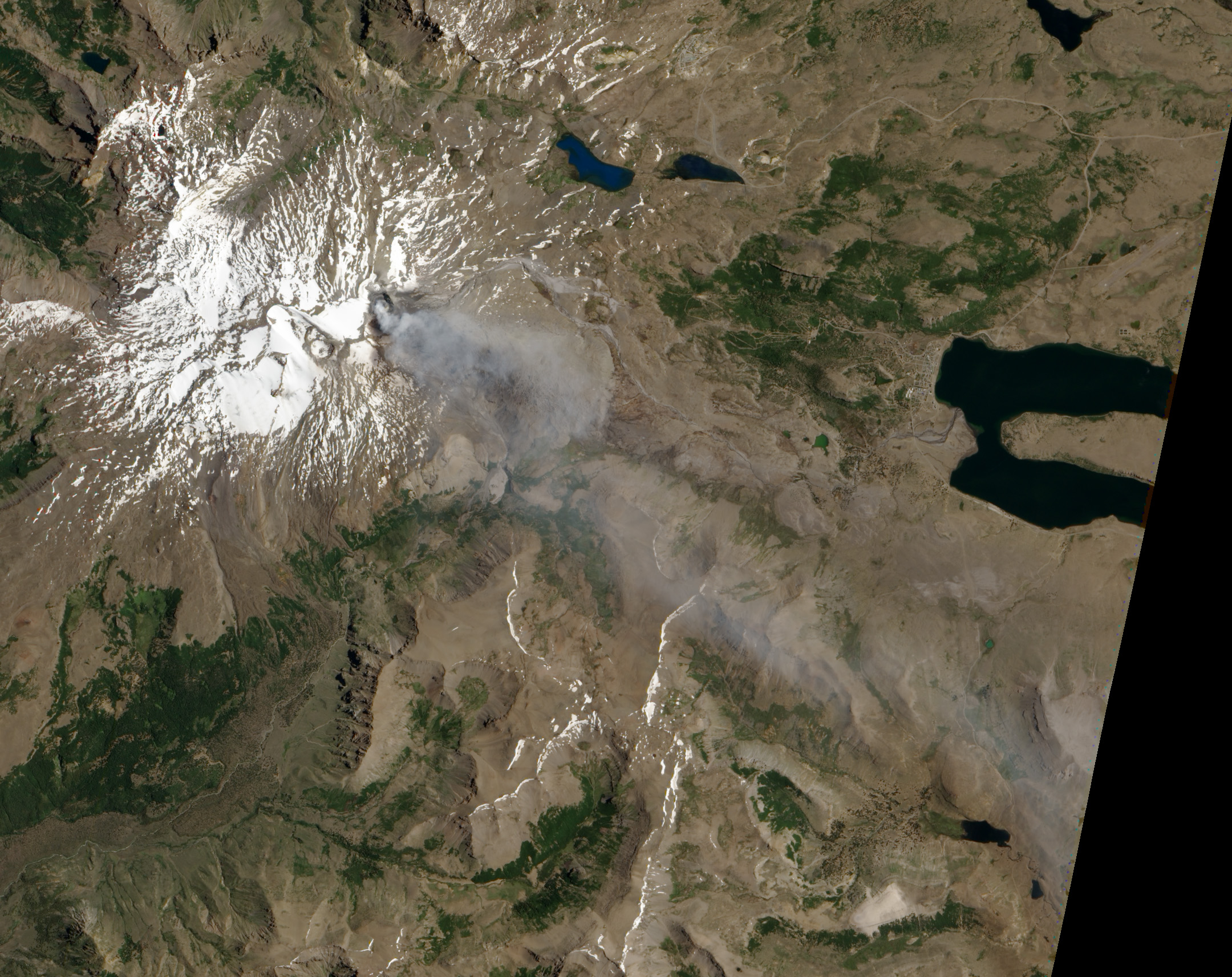
 Le SERNAGEOMIN indique que des panaches de gaz de couleur blanche s’élèvent jusqu’à 0,9-1,5 km au-dessus du cratère, suite à l’éruption phréatique qui a débuté le 22 décembre. On observe encore de l’incandescence certaines nuits. Les images satellites montrent des panaches de gaz qui s’étirent sur une dizaine de kilomètres en direction de E et du SE. Le niveau d’alerte reste à l’Orange.
 SERNAGEOMIN indicates that white gas plumes are still rising 0.9-1.5 km above the crater after the pheatic eruption that started on December 22nd. Incandescence is observed on some nights. Satellite images show gas plumes drifting 10 km E and SSE. The Alert Level remains at Orange.


 Claude Grandpey : Volcans et Glaciers