
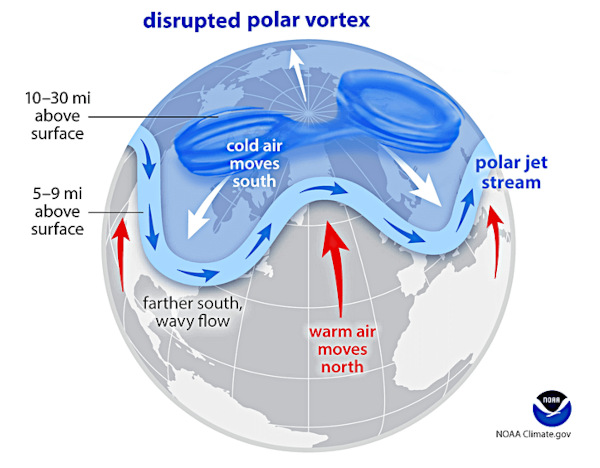
 Un réchauffement stratosphérique soudain (en anglais Sudden Stratospheric Warming ou SSW) est un phénomène météorologique pendant lequel le vortex polaire dans l’hémisphère hivernal voit ses vents généralement d’ouest ralentir ou même s’inverser en quelques jours. Un tel phénomène va rendre le vortex plus sinueux, voire le rompre. Le changement est dû à une élévation de la température stratosphérique de plusieurs dizaines de degrés au-dessus du vortex. Elle grimpe très rapidement, passant de -70/-80°C à -10/-20°C degrés (soit une élévation d’une soixantaine de degrés en quelques jours). Pour rappel, la stratosphère est la couche atmosphérique située au dessus de celle où nous vivons – la troposphère – à une altitude située entre 10 et 50 km environ.
Durant un hiver habituel dans l’hémisphère nord, plusieurs événements mineurs de réchauffement stratosphérique se produisent, avec un événement majeur environ tous les deux ans. Dans l’hémisphère sud, les SSW semblent moins fréquents et moins bien compris.
En conséquence, un réchauffement stratosphérique soudain et ses implications pour le vortex polaire peuvent avoir de sérieuses conséquences sur le climat de nos latitudes. L’air froid peut se retrouver piégé dans le jet stream (frontière entre l’air froid polaire et de l’air doux des tropiques) et être décalé jusqu’à nos latitudes, dans des régions peu habituées à un froid glacial, comme ce fut le cas en mars 2018 en Europe ou en février 2012 en France. Ces épisodes de SSW ne semblent toutefois pas avoir de relation avec le réchauffement climatique actuel ; ce sont de simples événements climatiques ponctuels.
**********
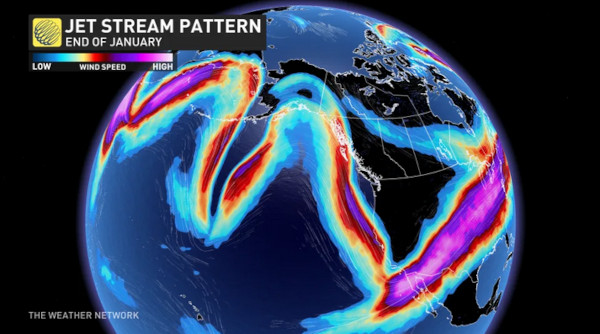
Une importante perturbation du vortex polaire a débuté et devrait envoyer de l’air arctique sur une grande partie de l’Amérique du Nord et de l’Europe jusqu’à la fin janvier 2026. Cet événement entraînera un temps hivernal avec des températures très froides. Comme indiqué plus haut, le vortex s’est affaibli suite à un épisode de réchauffement stratosphérique (SSW).
Une seconde perturbation, plus significative du vortex est prévue vers la fin janvier, avec une scission du vortex en deux parties autour du 25 janvier. Chacune d’elles poussera de l’air froid arctique vers l’Europe et l’Amérique du Nord en février.
Parallèlement, une puissante dorsale anticyclonique au Groenland devrait repousser de l’air arctique vers l’Europe durant cette période. Les prévisions indiquent une forte probabilité de températures inférieures à la moyenne dans le nord et le centre de l’Europe, notamment au Royaume-Uni, en France, en Allemagne et dans certaines régions d’Europe de l’Est.
Source : Centre européen pour les prévisions météorologiques à moyen terme (ECMWF).
——————————————————–
 A Sudden Stratospheric Warming (SSW) is a meteorological phenomenon during which the polar vortex in the winter hemisphere sees its generally westerly winds slow down or even reverse within a few days. Such a phenomenon will make the vortex more sinuous, or even break it. The change is due to a rise of several tens of degrees in stratospheric temperature above the vortex. It climbs very quickly, going from -70 / -80 ° C to -10 / -20 ° C degrees (an increase of about sixty degrees in a few days). As a reminder, the stratosphere is the atmospheric layer located above the one where we live – the troposphere – at an altitude between 10 and 50 km approximately.
During a typical winter in the northern hemisphere, several minor stratospheric warming events occur, with one major event occurring approximately every two years. In the southern hemisphere, SSWs appear to be less frequent and less well understood.
As a result, sudden stratospheric warming and its implications for the polar vortex can have serious consequences for the climate of our latitudes. Cold air can get trapped in the jet stream (border between cold polar air and mild tropical air) and be shifted to our latitudes, in regions not used to freezing cold, like this was the case in March 2018 in Europe or in February 2012 in France. However, these episodes of SSW do not seem to have any relation to current global warming; they are simple one-off climatic events.
**********
A major polar vortex disruption has begun and is forecast to send Arctic air into much of North America and Europe through mid and late January 2026. The event will bring freezing temperatures and winter weather as the vortex weakens following a stratospheric warming episode.
A second, stronger outbreak is forecast to occur during the last part of January as the core of the vortex splits into two halves around 25 January, each driving cold Arctic air into Europe and North America in February.
Meanwhile, a strong Greenland blocking ridge is forecast to drive Arctic air into Europe during this period. ECMWF forecasts show a high probability of below-average temperatures across northern and central Europe, including the United Kingdom, France, Germany, and parts of Eastern Europe.
Source : European Centre for Medium-Range Weather Forecasts (ECMWF).
 On parle beaucoup du vortex polaire ces jours-ci à propos de la vague de froid qui affecte les États Unis. Comme je l’ai expliqué précédemment (voir mes notes de janvier-février 2023), le vortex polaire est une vaste zone de basse pression dans la haute atmosphère au-dessus des pôles. Il est particulièrement fort en hiver et plus faible en été. En fait, le vortex polaire consiste plutôt en une circulation de vents puissants – courants jet – qui sont très forts au niveau des pôles mais peuvent également atteindre des latitudes plus basses.
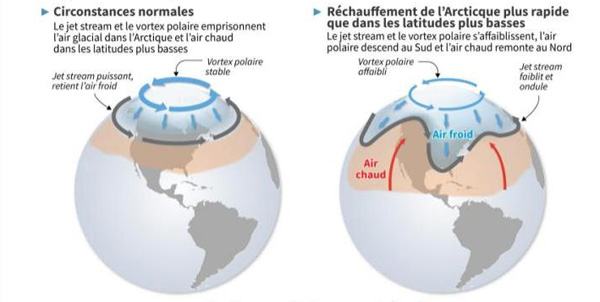
 There is a lot of talk about the polar vortex these days in connection with the cold snap affecting the United States. As I explained previously (see my January-February 2023 posts), the polar vortex is a large area of low pressure in the upper atmosphere that typically sits over the Earth’s poles. It is a persistent and large-scale circulation pattern that is created by the cold temperatures at the poles. It’s strongest in the winter and weakest in the summer. Actually, the polar vortex is rather a series of circulating winds – jet streams – that are strongest at the poles but can also extend to lower latitudes.
 On parle beaucoup du vortex polaire ces jours-ci et des voix se font entendre prédisant une possible arrivée d’air très froid dans certaines parties de l’hémisphère nord en février 2023.
 There is much talk about the polar vortex these days and voices can be heard predicting a possible arrival of very cold air in parts of the northern hemisphere in February 2023.
 Claude Grandpey : Volcans et Glaciers