
 Une nouvelle étude effectuée par des géochimistes italiens et présentée à la conférence Goldschmidt à Yokohama (Japon) le 30 juin 2016, semble indiquer que les déformations du sol dans la région des Champs Phlégréens près de Naples sont provoquées par la pression du gaz, non par une ascension de magma. Les Champs Phlégréens sont bien connus pour leur instabilité géologique. Le sol peut se soulever et s’affaisser de plusieurs mètres au cours d’un laps de temps de quelques années, phénomène connu sous le nom bradyséisme. Les dernières années ont vu le sol de la région se soulever à nouveau, avec une hausse de 38 centimètres enregistrée depuis la fin de 2005. On a même craint une éruption volcanique.
La dernière alerte géologique a eu lieu en 1982-1984, avec un soulèvement du sol jusqu’à 1,80 m. La plupart des scientifiques pensent que le phénomène a été causé par une activité hydro-magmatique. A côté de cette idée, un groupe de chercheurs explique l’activité actuelle par une accumulation du magma sous les Campi Flegrei.
Aujourd’hui, des géochimistes de l’Université de Naples et de l’Observatoire du Vésuve pensent que le groupe de chercheurs fait fausse route. Ils ont examiné des données géochimiques remontant à plus de 30 ans et leur interprétation – qui prend en compte les gaz émis et les signaux physiques – rejoint l’hypothèse selon laquelle l’activité actuelle est hydrothermale, avec participation des gaz magmatiques profonds. Ces géochimistes ne pensent pas qu’il y ait migration du magma ou gonflement d’une chambre magmatique superficielle.
C’est une bonne nouvelle. En effet, l’activité au cours de laquelle le magma s’accumule avant de se déplacer vers la surface tend à être associée à un risque d’éruption. Il faut toutefois remarquer que le passage d’une activité hydrothermale à une activité magmatique peut se produire brutalement. Il est donc très difficile de prévoir l’activité future des Champs Phlégréens. Pour mettre en place une interprétation définitive de la situation, il faudrait pouvoir avoir un accès au comportement géophysique et géochimique du sous-sol de cette région. Cependant, comme je l’ai écrit dans plusieurs notes, il existe des désaccords concernant la sécurité des forages dans la région. Les autorités craignent qu’ils déstabilisent le sous-sol et provoquent une activité éruptive.
Source: Phys.org: http://phys.org/
————————————–
 A new study by Italian geochemists, presented at the Goldschmidt conference in Yokohama, Japan, on 30 June 2016, seems to indicate that the current ground movement around the Campi Flegrei in the Naples area may be due to gas pressure, and not because of a surge of volcanic magma. The Campi Flegrei (Phlegraean Fields) is well known for its geological instability. The land in this area can rise and fall by several metres over just a few years, a phenomenon known as Bradyseism. The last few years have seen the ground in the area begin to rise again, with a 38-centimetre rise recorded since late 2005. There have been worries that this may presage an eruption.
The last serious geological unrest was in 1982-1984, which saw ground levels rise by up to 1.8 metres. Most scientists think that the movement in this period was caused by mixed magmatic- hydrothermal activity. On the other hand, consensus exists that the current activity is caused by molten magma movement and accumulation under the Campi Flegrei.
Now, however, a group of geochemists from the University of Naples and the Vesuvius Observatory think that the consensus has got it exactly the wrong way round. They have checked geochemical records going back over more than 30 years, and their interpretation – which takes into account the released gases and physical signals – seems to be consistent with current activity being hydrothermal, with the support of deep magmatic gases, rather than due to magma migration or growth of a shallow magma chamber.
This is good news. Indeed, activity in which magma moves upward and accumulates tends to be associated with an increased chance of an eruption. However the change from hydrothermal to magmatic activity can take place at any time, so it is very difficult to predict future activity in the Campi Flegrei. Achieving a definitive interpretation of the situation would probably require direct access to underground geochemical and geophysical information in the areas of interest. However, as I put it in previous posts, there is still a debate over the safety of drilling in such a volatile area.
Source: Phys.org: http://phys.org/
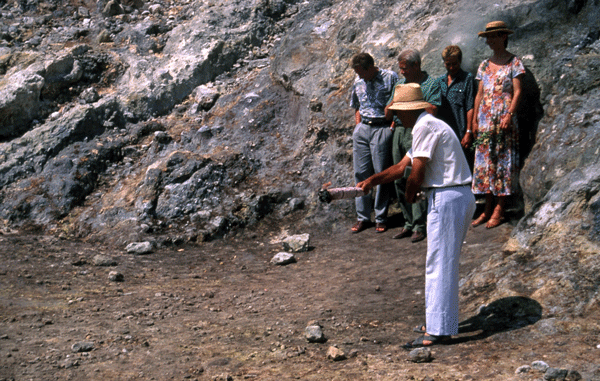
Expérience d’ionisation dans la Solfatara : Le journal enflammé approché d’une fumerolle fait redoubler la fumée de la fumerolle. En effet, l’ion d’ammonium contenu dans le papier se combine avec les ions chlorures des fumerolles pour donner des vapeurs blanches visibles de chlorure d’ammonium. (Photo: C. Grandpey)




 Claude Grandpey : Volcans et Glaciers