 J’ai écrit plusieurs articles sur ce blog à propos de l’A23a, un immense iceberg qui s’est détaché de la plateforme glaciaire Filchner-Ronne en Antarctique en 1986. Aujourd’hui, l’iceberg se fragmente rapidement dans l’Atlantique Sud.
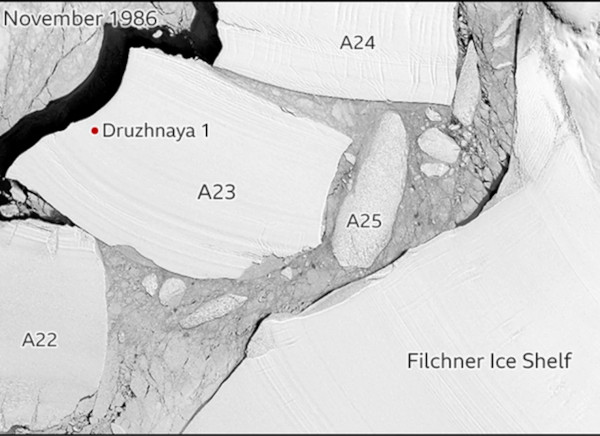
Source: NASA
Des images satellite récentes indiquent que des portions d’environ 400 km² se sont détachées ces dernières semaines, tandis que de nombreux fragments plus petits dérivent à proximité.
L’A23a a été qualifié à plusieurs reprises de « plus grand iceberg au monde », même s’il a parfois été dépassé par des icebergs plus grands mais à durée de vie plus courte, notamment l’A68 en 2017 et l’A76 en 2021. Il est resté le plus grand iceberg dérivant librement à la surface de l’océan jusqu’à la mi-2025. Il mesurait 3 460 km² début mars 2025. Cependant, le 22 juillet, sa superficie était tombée à 2 510 km². En septembre 2025, il mesurait environ 1 770 km², avec une largeur maximale de 60 km. Sa masse était estimée à près de 1 000 milliards de tonnes.
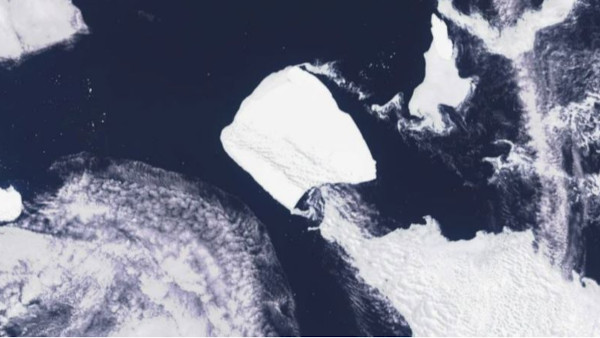
Source: NASA
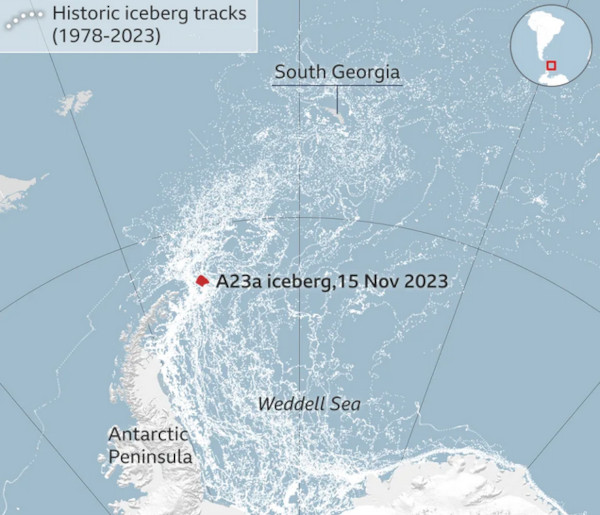
L’iceberg est resté coincé dans la mer de Weddell pendant plus de trois décennies avant d’être emporté vers le nord par les courants en 2020. Ensuite, il a pénétré dans les eaux de plus en plus chaudes de l’Atlantique Sud, où la fonte de sa base a fragilisé sa structure.
En 2020, il a été emporté par les courants océaniques avant de se retrouver coincé dans un vortex (colonne de Taylor) provoqué par des courants océaniques venant heurter une montagne sous-marine. L’iceberg s’est alors mis à tourner comme une toupie. J’ai décrit le phénomène dans cet article :
https://claudegrandpeyvolcansetglaciers.com/2024/08/17/iceberg-a-23a-une-toupie-antarctique-iceberg-a-23a-an-antarctic-spinning-top/
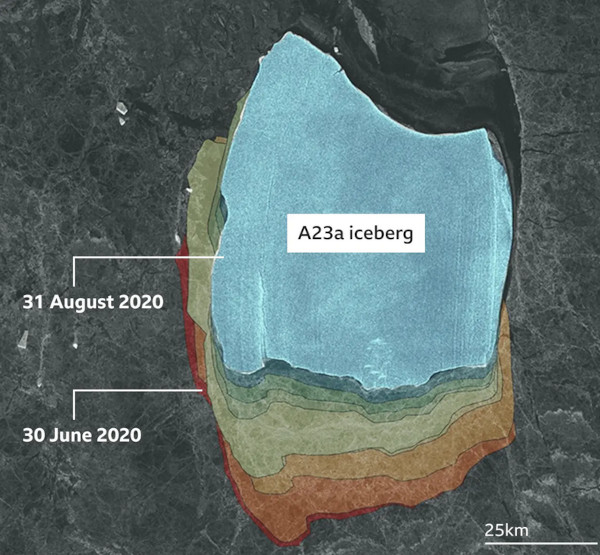
Source: BAS
L’A23a a recommencé à se déplacer en décembre 2024.
Début mars 2025, il s’est échoué sur le plateau continental de la Géorgie du Sud, suscitant des inquiétudes quant à l’accès aux zones d’alimentation des phoques et des manchots :
https://claudegrandpeyvolcansetglaciers.com/2025/03/04/liceberg-a23a-nentrera-pas-en-collision-avec-la-georgie-du-sud-iceberg-a23a-will-not-collide-with-south-georgia/
Plus tard en mars 2025, il s’est échoué sur un plateau continental avant de repartir à la dérive en mai.
https://claudegrandpeyvolcansetglaciers.com/2024/12/15/liceberg-a23a-de-nouveau-en-mouvement-iceberg-a23a-again-on-the-move/
L’iceberg A23a est aujourd’hui en cours de désintégration car il a été emporté par le front du Courant circumpolaire antarctique sud (SACCF) dans le sens inverse des aiguilles d’une montre autour de la Géorgie du Sud. Ce courant devrait emporter l’iceberg et ses fragments vers le nord-est, où il connaîtra un destin semblable à celui d’autres méga-icebergs, tels que l’A68 en 2021 et l’A76 en 2023. Eux aussi se sont désintégrés autour de la Géorgie du Sud.
La désintégration de l’A23a signifie que le plus grand iceberg du monde est désormais le D15a, qui mesure environ 3 000 km².
Source : British Antarctic Survey, U.S. National Ice Center.
———————————————-
 I have written several posts on this blog about A23a, ahuge iceberg which calved from Antarctica’s Filchner-Ronne Ice Shelf in 1986. Today, the iceberg is rapidly breaking apart in the South Atlantic.
Recent satellite images indicate that sections measuring around 400 km2 have detached in recent weeks, with numerous smaller fragments drifting nearby.
A23a has been named several times the “largest current iceberg”, occasionally being surpassed by larger but shorter-lived icebergs, including A68 in 2017 and A76 in 2021. It was the world’s largest freely floating iceberg through mid-2025, measuring 3 460 km2 in early March 2025. However, by July 22 it had been reduced to 2 510 km2. As of September 2025, it measures about 1 770 km2, with a maximum width of 60 km. Its mass is estimated at nearly 1 trillion tons.
The iceberg remained grounded in the Weddell Sea for over three decades before currents carried it northward in 2020. Since then, it has entered progressively warmer waters of the South Atlantic, where basal melting has weakened its structure.
In 2020, it was carried away by ocean currents before becoming stuck again in a spinning vortex of water caused by ocean currents hitting an underwater mountain. I described the phenomenon in this post :
A23a started moving again in December 2024.
In early March 2025, A23a grounded on South Georgia’s continental shelf, raising concerns over access to feeding areas for seals and penguins :
Later in March 2025 it ran aground on a continental shelf before floating loose again in May.
A23a broke up because it followed the Southern Antarctic Circumpolar Current Front (SACCF) anti-clockwise around South Georgia.This current is likely to ultimately take the berg and its bits off to the north-east, following a similar fate to other megabergs, such as A68 in 2021 and A76 in 2023, which also disintegrated around South Georgia.
The disintegration of A23a means the world’s largest iceberg is now D15a, which measures around 3 000 km2.
Source : British Antarctic Survey, U.S. National Ice Center.
 Cela aurait pu être une catastrophe pour la biodiversité en Antarctique, mais ce n’en sera pas une. L’A23a, le plus gros iceberg au monde avec ses mille milliards de tonnes de glace menaçait de s’immobiliser contre la Géorgie du Sud, une île britannique située entre l’Antarctique et l’Amérique du Sud, avec un risque certain pour la faune locale. Il s’est finalement échoué, à près de 70 kilomètres des côtes. après avoir dérivé pendant cinq ans, et il finira par se briser en plusieurs morceaux qui continueront de dériver librement dans l’océan Austral.
 It could have been a disaster for biodiversity in Antarctica, but it will not be. A23a, the largest iceberg in the world with its trillion tons of ice, threatened to come to rest against South Georgia, a British island located between Antarctica and South America, with a certain risk for the local fauna. It finally ran aground, nearly 70 kilometers from the coast. after drifting for five years, and it will eventually break into several pieces that will continue to drift freely in the Southern Ocean.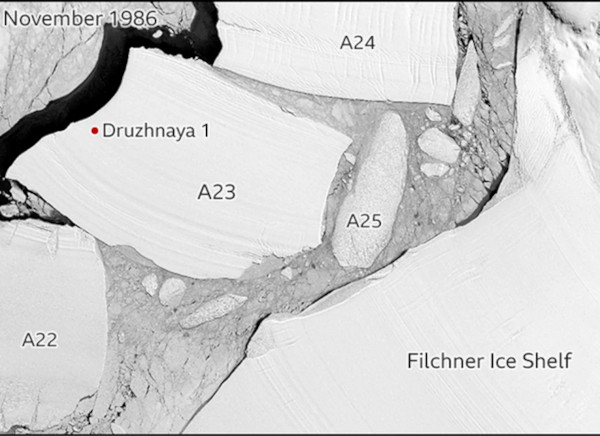
 Souvenez-vous (voir mes notes entre août 2017 et avril 2021) : en juillet 2017, un immense iceberg baptisé A68 s’est détaché de la plate-forme glaciaire Larsen C en Antarctique. Le bloc de glace couvrait alors une superficie de près de 6 000 km2. Après avoir fondu en dérivant sur l’océan, l’iceberg a finalement cessé d’exister en février 2021.
 Remember (see my posts between August 2017 and April 2021) : in July 2017, a huge iceberg dubbed A68 broke free from the Larsen C ice shelf in Antarctica. It then covered an area of nearly 6,000 km2. After melting while drifting on the ocean, the iceberg’slife finally came to an end in February 2021.

 Claude Grandpey : Volcans et Glaciers