
 Quand je lis des articles de la presse grand public à propos du réchauffement climatique et de ses conséquences, j’ai l’impression que cette situation est une découverte pour les journalistes, alors que je lance des messages d’alerte depuis longtemps sur ce blog. Le public met vraiment du temps à assimiler les conséquences de la hausse des températures !
Un article paru sur le site de France Info nous explique que « des petites îles apparaissent au Groenland à cause du changement climatique et de la fonte des calottes glacières. Alors que, dans de nombreux endroits du globe, la fonte des glaces contribue à faire monter le niveau de la mer et à submerger certaines zones, au Groenland : c’est l’inverse qui se produit. En fondant, la glace allège le poids qui repose sur le socle de ce territoire de 2, 2 millions de kilomètres carrés, et contribue à l’élévation du niveau du sol. »
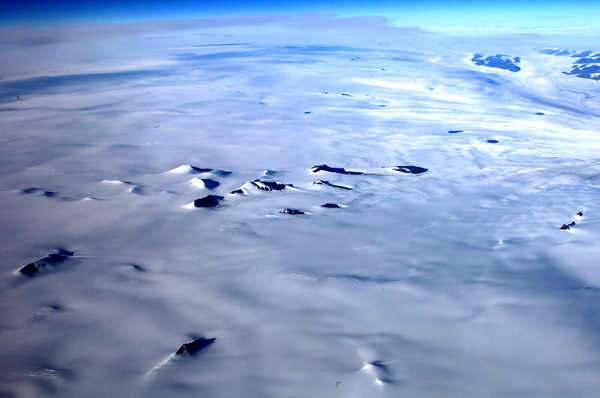
Photo: C. Grandpey
Ce n’est pas nouveau. Il s’agit d’un phénomène appelé « rebond isostatique » que l’on observe également en Islande (voir, par exemple, ma note du 17 mai 2022). Dans ce pays, certains scientifiques se demandent même si l’allègement de la masse glaciaire au-dessus des volcans ne pourrait pas favoriser la remontée du magma. La fonte des glaciers étant un phénomène relativement récent, nous n’avons pas suffisamment de recul pour tirer des conclusions. Pour le moment, aucun événement éruptif significatif n’est venu corroborer cette hypothèse.
S’agissant du Groenland, des chercheurs de l’Institut de l’université technique du Danemark ont réussi à mesurer très précisément ce phénomène sur une période récente. En analysant les données d’un réseau d’une soixantaine de stations GPS situées le long des côtes groenlandaises, les scientifiques ont constaté que le socle rocheux s’est élevé de 20 cm en l’espace de 10 ans, entre 2013 et 2023. Cela fait donc deux mètres d’élévation en un siècle. (NDLR : cela suppose que le rebond isostatique a commencé dans les décennies de début du 20ème siècle). Ce phénomène entraîne l’apparition de nouveaux îlots. Ce ne sont que des cailloux pour l’instant mais à terme, les chercheurs pensent que « la superficie totale du Groenland va augmenter, et ce phénomène est à mettre en lien avec le changement climatique dû aux activités humaines. »
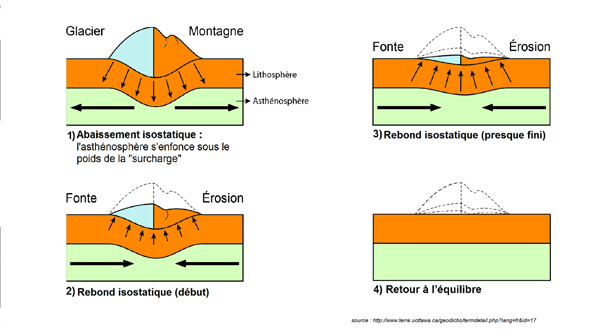
Schéma illustrant le rebond isostatique (Source: https://profsvt.site)
Une autre découverte faite au Groenland révèle que, grâce à la présence d’une catégorie spécifique bactéries dans le sol, certaines zones sèches du Groenland absorbent du méthane. En moyenne depuis 20 ans, les zones sèches et non glacées du Groenland auraient absorbé sept fois plus de méthane que n’en ont rejeté les zones humides. L’île arctique est donc un puits pour le méthane, ce qui est plutôt une bonne nouvelle, même si cela est loin de compenser les émissions de méthane de la Sibérie, qui subit de son côté le dégel du permafrost, un sujet que j’ai abordé dans plusieurs notes sur ce blog.
————————————————
 When I read articles from the general press about global warming and its consequences, I have the feeling that this situation is a discovery for journalists, even though I have been warning for a long time on this blog. The population is really taking time to assimilate the consequences of rising temperatures!
An article published on the France Info website explains that “small islands are appearing in Greenland because of climate change and the melting of the ice caps. While in many places around the world melting ice contributes to rising sea levels and submerging certain areas, in Greenland the opposite is happening. By melting, the ice lightens the weight resting on the bedrock of this territory of 2.2 million square kilometers, and contributes to the rise in ground level. »
This is not new. This is a phenomenon called “isostatic rebound” which is also observed in Iceland (see, for example, my post of May 17th, 2022). In this country, some scientists even wonder if the reduction of the glacial mass above volcanoes could not favour the ascent of magma. The melting of glaciers being a relatively recent phenomenon, we do not have enough hindsight to draw conclusions. For the moment, no significant eruptive event has corroborated this hypothesis.
Regarding Greenland, researchers from the Institute of the Technical University of Denmark have succeeded in measuring this phenomenon very precisely over a recent period. By analyzing data from a network of around sixty GPS stations located along the Greenlandic coast, scientists found that the bedrock has risen by 20 cm in the space of 10 years, between 2013 and 2023. That’s two meters of elevation in a century. (Editor’s note: This assumes that the isostatic rebound began in the early decades of the 20th century). This phenomenon has led to the appearance of new islets. These are only pebbles for the moment, but in the long term, the researchers believe that « the total surface area of Greenland will increase, and this phenomenon is linked to climate change caused by human activities. »
Another discovery made in Greenland reveals that, thanks to the presence of a specific category of bacteria in the soil, certain dry areas of Greenland absorb methane. On average over the past 20 years, dry, ice-free areas of Greenland have absorbed seven times more methane than wet areas have released. The Arctic island is therefore a sink for methane, which is rather good news, even if it is far from compensating the methane emissions from Siberia, which is undergoing the thaw of permafrost, a subject that I I have discussed in several posts on this blog.
 Claude Grandpey : Volcans et Glaciers