Le Nyiragongo (République Démocratique du Congo) vu depuis l’espace

drapeau francaisLa NASA a mis en ligne une image du Nyiragongo prise depuis l’espace le 4 août 2013. On voit un très volumineux panache de gaz et de vapeur d’eau s’échapper du volcan. De ce fait, l’intérieur du cratère et le lac de lave ne sont pas visibles. Rappelons que la densité d’un panache de vapeur d’eau ne doit pas être mise en relation uniquement avec l’activité éruptive, mais avant tout avec l’hygrométrie et la température de l’air ambiant. Ainsi, sur l’île italienne de Vulcano, les volumineux panaches qui s’échappent parfois du cratère de la Fossa ne signifient pas que le volcan est en train de se réveiller !


drapeau anglaisNASA has posted an image of Nyiragongo taken from space on August 4th, 2013. We can see a voluminous plume of gas and water vapour coming out of the volcano. Therefore, the interior of the crater and the lava lake are not visible. Let’s keep in mind that the density of a plume of water vapour should not be related only with eruptive activity, but above all with the humidity and temperature of the ambient air. Thus, on the Italian island of Vulcano, the large plumes that sometimes come out of the Fossa crater do not mean that the volcano is waking up!

Nyiragongo-aout-2013

Nyiragongo & Nyiamuragira (République Démocratique du Congo)

drapeau francaisLa NASA a mis en ligne une image du Nyiragongo et du Nyiamuragira ( les couleurs ne sont pas réelles) acquise par le satellite Landsat 8 le 29 juillet 2013.

Le Nyiragongo héberge un lac de lave permanent trahi par la lueur rouge de la lumière infrarouge ondes courtes. Un panache de gaz bleu et peu épais s’échappe du Nyiragongo et se dirige vers le nord, cachant en partie le Nyiamyragira. La couleur blanche du panache du Nyiamuragira indique la présence d’une importante quantité de vapeur d’eau.


drapeau anglaisNASA has released an image of Nyiragongo and Nyiamuragira volcanoes taken by the Landsat 8 satellite on July 29th 2013.

Nyiragongo features a persistent lava lake, revealed by the red glow of shortwave infrared light. A translucent blue volcanic plume stretches north from Nyiragongo, partially shrouding Nyamuragira. The plume from Nyamuragira is dense and white, suggesting the presence of large amounts of water vapour.

Nyiragongo-2

(Avec l’aimable autorisation de la NASA)

Le Mont Fuji et la Voie Lactée // Mount Fuji and the Milky Way

drapeau francaisEn cliquant sur le lien ci-dessous vous verrez une photo de nuit très originale du Mont Fuji (Japon) avec la Voie Lactée qui donne l’impression qu’un panache de gaz s’échappe du sommet. Les randonneurs et leurs lampes donnent l’illusion – avec le temps de pose un peu long – qu’une coulée de lave avance sur le flanc du volcan.

http://www.universetoday.com/103569/incredible-astrophoto-the-milky-way-and-mt-fuji-as-a-galactic-volcano/

A côté de cela, plusieurs articles rappellent ces jours-ci qu’un séisme de forte intensité pourrait contribuer à déclencher une éruption. La dernière a eu lieu en 1707 et les scientifiques japonais sont persuadés que la pression s’est accrue dans la chambre magmatique. Cette hypothèse a déjà été évoquée après le terrible séisme de M 8,9 du 11 mars 2011. Pourtant, aucun signe de réveil du Mont Fuji n’a été observé depuis cette date.


drapeau anglaisBy clicking on the link below you will see a very original night photo of Mount Fuji (Japan) with the Milky Way which gives the impression that a plume of gas is escaping from the summit. The hikers and their lamps give the illusion – with the fairly long exposure – that a lava flow is travelling down the flank of the volcano.
http://www.universetoday.com/103569/incredible-astrophoto-the-milky-way-and-mt-fuji-as-a-galactic-volcano/

Besides, several articles remind us these days that a strong earthquake could help trigger an eruption. The last one took place in 1707 and Japanese scientists are convinced that pressure has increased in the magma chamber. This hypothesis has already been put forward after the terrible earthquake (M 8.9) on 11 March 2011. However, no signs of awakening of Mount Fuji has been observed since.

Fuji-blog

Le Mont Fuji de jour  (Crédit photo:  Wikipedia)

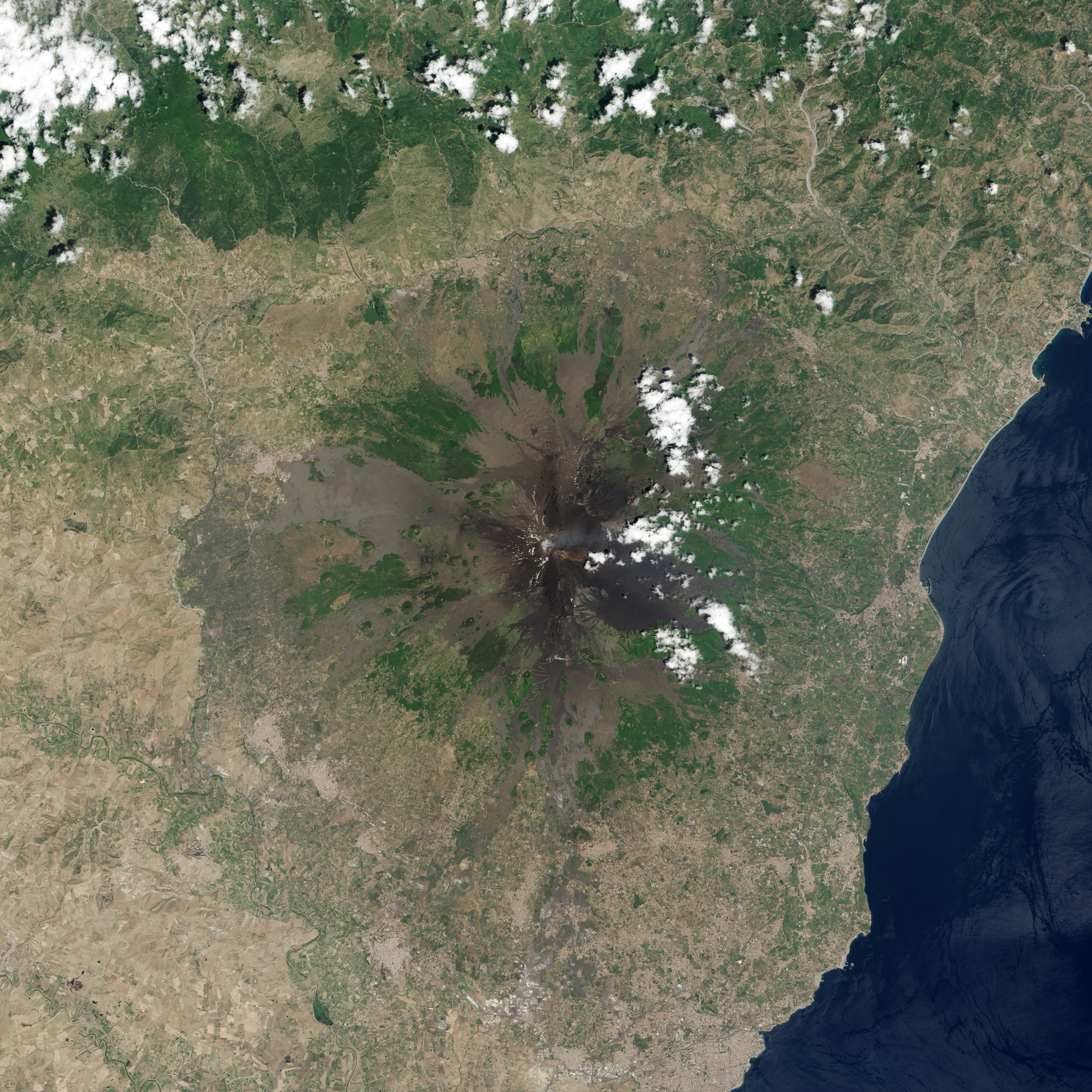
Etna (Sicile / Italie): Situation très calme !

drapeau francais   La situation est actuellement très calme sur l’Etna où seul un dégazage anime le Cratère Central et son homologue du NE, comme on peut le voir sur une image mise en ligne par la NASA. La photo a été prise le 4 juin 2013. Vous obtiendrez une image de bonne résolution en cliquant sur ce lien :

http://eoimages.gsfc.nasa.gov/images/imagerecords/81000/81306/etna_oli_2013155_lrg.jpg

Une autre très belle photo a été prise par l’épouse de l’ami Boris Behncke (INGV Catane) lors d’un survol en hélicoptère. On s’aperçoit que le Cratère SE est plongé dans un profond sommeil. Le Nouveau Cratère SE dresse sa masse devant son aîné. On se rend compte du volume de lave vomi par l’Etna au cours des différents paroxysmes qui ont secoué ce cratère:

https://www.facebook.com/groups/abc.volcanoes/permalink/10151635373084528/#!/photo.php?fbid=10201105714754429&set=a.1754342787797.2100783.1515764014&type=1&theater


drapeau anglais   The situation is currently very quiet on Mount Etna. The only activity to be seen is some degassing from the Central Crater and the NE Crater, as can be seen on an image released by NASA. The photo was acquired on June 4th 2013. You’ll get a higher resolution image by clicking on this link:

http://eoimages.gsfc.nasa.gov/images/imagerecords/81000/81306/etna_oli_2013155_lrg.jpg

Another great photo was taken by Boris Behncke’s wife during a helicopter overflight. One can see that the SE Crater is sound asleep. The New SE Crater stands in front of the Old one. One realises the huge volume of lava emitted by the volcano during the different paroxysms that have shaken this crater:

https://www.facebook.com/groups/abc.volcanoes/permalink/10151635373084528/#!/photo.php?fbid=10201105714754429&set=a.1754342787797.2100783.1515764014&type=1&theater

Etna-4-juin-2013

(Avec l’aimable autorisation de la NASA)