Hunga-Tonga-Hunga-Ha’apai (Tonga): Faut-il s’attendre à d’autres éruptions? // Should we expect more eruptions?

L’éruption du volcan Hunga-Tonga-Hunga-Ha’apai le 15 janvier 2022 a été si violente qu’elle a envoyé des ondes de choc à travers quasiment la moitié du globe terrestre. Le site The Conversation apporte des informations très intéressantes sur l’éruption proprement dite et sur l’histoire de ce volcan.
Le volcan se compose de deux petites îles inhabitées, Hunga-Ha’apai et Hunga-Tonga qui s’élèvent à une centaine de mètres au-dessus du niveau de la mer, à 65 km au nord de la capitale des Tonga, Nuku’alofa. Mais sous la surface de la mer se cache un volcan beaucoup plus imposant, d’environ 1800 m de hauteur et 20 km de largeur.
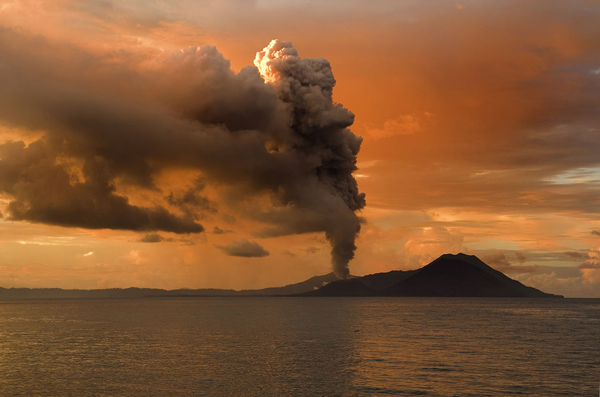
Le volcan Hunga-Tonga-Hunga-Ha’apai est entré en éruption régulièrement au cours des dernières décennies. Lors des éruptions de 2009 et 2014-2015, il a propulsé d’impressionnantes gerbes cypressoïdes typiques des éruptions phréato-magmatiques. Cependant, ces éruptions étaient mineures et ont été largement éclipsées par les événements de janvier 2022. Si on se réfère à l’histoire du volcan, il semble que la dernière éruption majeure fasse partie d’une série d’événements qui se produisent environ tous les mille ans.
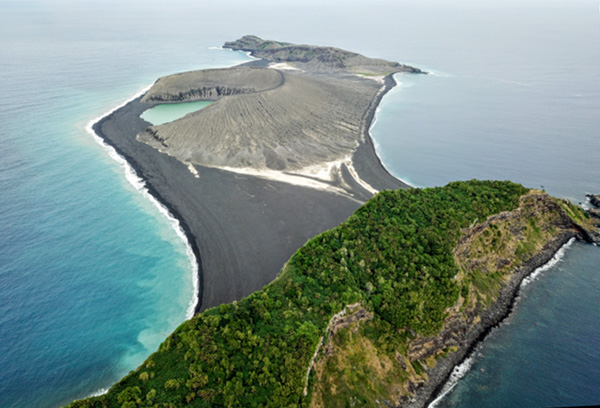
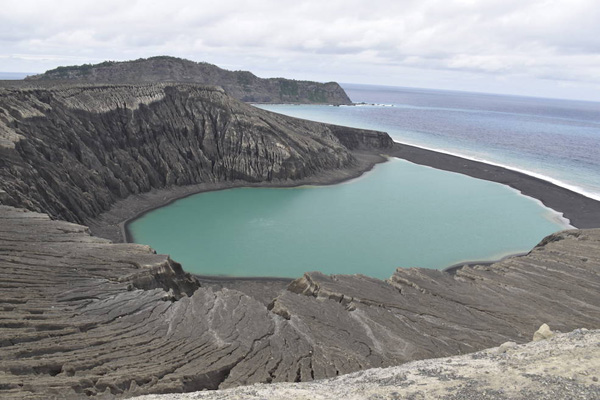
L’éruption de 2014-2015 a créé un cône volcanique qui a réuni les deux anciennes îles Hunga pour créer une île double d’environ 5 km de long.
Source: NASA

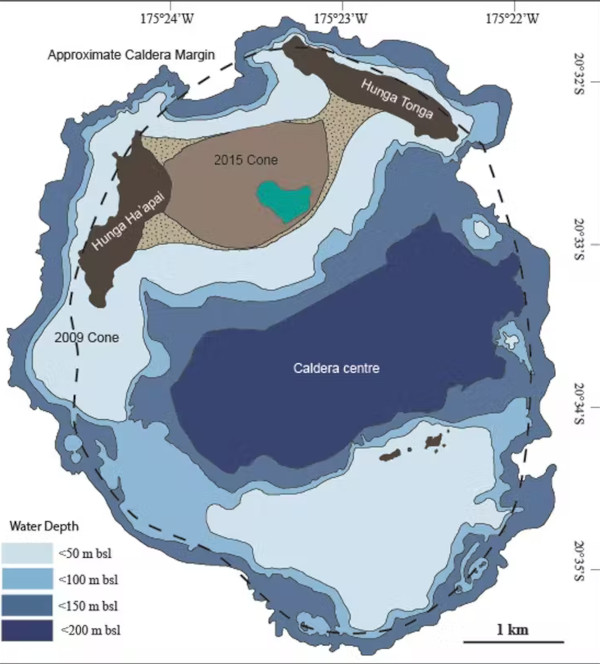
Lorsque les scientifiques ont cartographié le plancher océanique en 2016, ils ont découvert une caldeira qui se cache à 150 mètres de profondeur sous la surface de la mer. La caldeira mesure environ 5 km de diamètre.
 

Source: The Conversation

Les éruptions mineures (comme celles de 2009 et 2014-2015) se produisent principalement au bord de la caldeira, mais les très grosses éruptions naissent au coeur de la caldeira proprement dite. Ces grandes éruptions sont si importantes que le sommet de la colonne magmatique s’effondre vers l’intérieur de la caldeira et contribue à son approfondissement.
En étudiant la chimie des éruptions passées, on se rend compte que les éruptions mineures correspondent à la lente recharge du système magmatique et annonce le déclenchement d’un événement majeur.

Les scientifiques ont trouvé des preuves de deux énormes éruptions passées de la caldeira Hunga dans des dépôts sur les anciennes îles. Ils ont comparé les analyses chimiques de ces dépôts à des échantillons de cendres prélevés sur la plus grande île habitée de Tongatapu, à 65 km, puis ont utilisé des datations au Carbone 14; il s’avère que de grandes éruptions se produisent dans la caldeira environ tous les 1000 ans, la dernière ayant eu lieu vers 1100. Il semble donc que l’éruption du 15 janvier 2022 soit en plein dans le cycle des événements majeurs.
Les auteurs de l’article de The Conversation ont tenté de prévoir ce qui pourrait arriver par la suite à Hunga-Ha’apai et Hunga-Tonga. Les deux éruptions du 20 décembre 2021 et du 13 janvier 2022 étaient modérées. Elles ont généré des panaches qui se sont élevés jusqu’à 17 km et ont agrandi l’île double qui était apparue en 2014-2015.
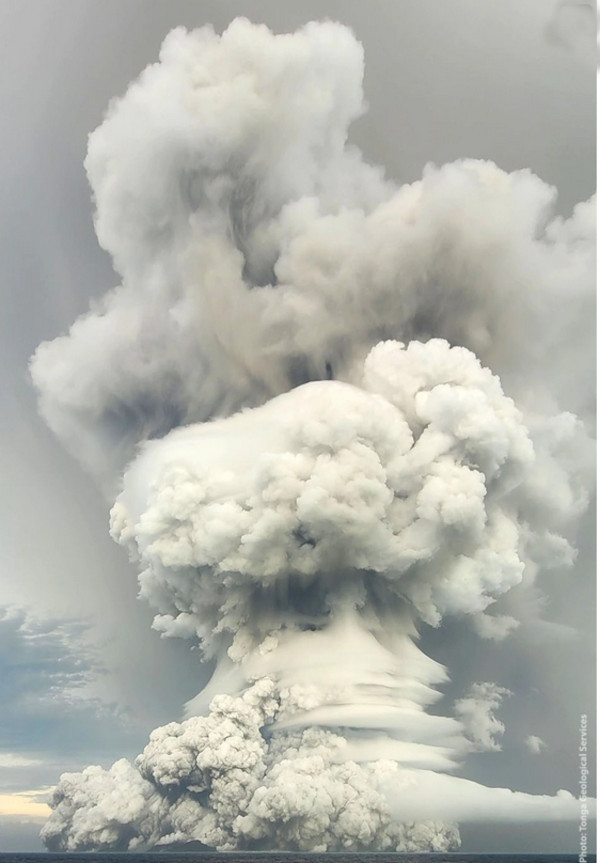
La dernière éruption a montré une autre échelle de grandeur. Le panache de cendres est monté à environ 20 km de hauteur. Il s’est étendu de manière concentrique sur une distance d’environ 130 km par rapport au volcan, créant un panache de 260 km de diamètre. Cela démontre une énorme puissance explosive qui ne peut être expliquée par la seule interaction entre le magma et l’eau de mer. Cela montre que de grandes quantités de magma juvénile chargé de gaz se sont échappées de la caldeira.
Source: Tonga Services

L’éruption a également produit un tsunami à travers les Tonga et les Fidji et Samoa voisins. Les ondes de choc ont parcouru plusieurs milliers de kilomètres, ont été observées depuis l’espace et enregistrées en Nouvelle-Zélande à environ 2000 km.
Tous ces événements laissent supposer que la grande caldeira Hunga a repris du service. Les vagues de tsunami ont probablement été causées par des glissements de terrain sous-marins et des effondrements de la caldeira
Reste à savoir si l’événement du 15 janvier 2022 est le point culminant de l’éruption. Il représente la libération d’une importante pression magmatique, ce qui peut contribuer à stabiliser le système. Cependant, les dépôts géologiques des éruptions précédentes de ce volcan montrent que chacun des épisodes éruptifs millénaires majeurs de la caldeira incluait de nombreux événements explosifs. Il se pourrait donc que la dernière grande éruption ne soit pas un événement isolé et que de nouveaux épisodes majeurs d’activité se produisent pendant plusieurs semaines, voire des années sur le volcan Hunga-Tonga-Hunga-Ha’apai.
Source : The New Zealand Herald, The Conversation.

————————————————

The Hunga-Ha’apai and Hunga-Tonga eruption of January 15th, 2022 was so violent that it sent shock waves, quite literally, around half the world. The website The Conversation brings very interesting information about the eruption itself and about the history of this volcano.

The volcano consists of two small uninhabited islands, Hunga-Ha’apai and Hunga-Tonga, rising about 100 m above sea level 65 km north of Tonga’s capital Nuku‘alofa. But hiding below the waves is a massive volcano, around 1800 m high and 20 km wide.

The Hunga-Tonga-Hunga-Ha’apai volcano has erupted regularly over the past few decades. During eruptions in 2009 and 2014-2015, the volcano sent impressive cypressoid sheaves typical of phreato-magmatic eruptions. However, these eruptions were small and dwarfed in scale by the January 2022 events. Looking at the history of the volcano, it looks as if the last eruption is one of the massive explosions the volcano is capable of producing roughly every thousand years.

The 2014-2015 eruption created a volcanic cone, joining the two old Hunga islands to create a combined island about 5km long.

When scientists mapped the sea floor in 2016, they discovered a hidden caldera 150 meters below the waves. The caldera is about 5 km across. Small eruptions (such as in 2009 and 2014-2015) occur mainly at the edge of the caldera, but very big ones come from the caldera itself. These big eruptions are so large the top of the erupting magma collapses inward, deepening the caldera.

Looking at the chemistry of past eruptions, it is thought the small eruptions represent the magma system slowly recharging itself to prepare for a big event.

Scientists found evidence of two huge past eruptions from the Hunga caldera in deposits on the old islands. They matched these chemically to volcanic ash deposits on the largest inhabited island of Tongatapu, 65 km away, and then used radiocarbon dates to show that big caldera eruptions occur about ever 1000 years, with the last one at AD1100. With this knowledge, the eruption on January 15th, 2022 seems to be right on schedule for a major event.

The authors of the article in The Conversation tried to figure out what could happen next at Hunga-Ha’apai and Hunga-Tonga. The two earlier eruptions on December 20th, 2021 and January 13th, 2022 were of moderate size. They produced clouds that rose up to 17 km and added new land to the 2014-2015 combined island.

The latest eruption has stepped up the scale in terms of violence. The ash plume is already about 20 km high. It spread out almost concentrically over a distance of about 130 km from the volcano, creating a plume with a 260 km diameter, before it was distorted by the wind. This demonstrates a huge explosive power which cannot be explained by magma-water interaction alone. It shows instead that large amounts of fresh, gas-charged magma have erupted from the caldera.

The eruption also produced a tsunami throughout Tonga and neighbouring Fiji and Samoa. Shock waves traversed many thousands of kilometres, were seen from space, and recorded in New Zealand some 2000 km away.

All these signs suggest the large Hunga caldera has awoken. The tsunami waves may have been caused by submarine landslides and caldera collapses

It remains unclear if this is the climax of the eruption. It represents a major magma pressure release, which may settle the system. However, the geological deposits from the volcano’s previous eruptions show that each of the 1000-year major caldera eruption episodes involved many separate explosion events. Hence, the last big eruption might not be an isolated event and we could be in for several weeks or even years of major volcanic unrest from the Hunga-Tonga-Hunga-Ha’apai volcano.

Source: The New Zealand Herald, The Conversation.

https://theconversation.com/fr

L’onde de choc du Tavurvur : Approche scientifique // Tavurvur’s shock wave: A scientific approach

drapeau-francaisA l’issue de la diffusion de ma note sur l’éruption spectaculaire du Tavurvur en 2014 et l’apparition d’une puissante onde de choc, j’avais sollicité l’aide d’un physicien pour obtenir des explications plus précises. Voici les remarques de Philippe Thoré à qui j’adresse mes très sincères remerciements.

Elles se situent à plusieurs niveaux :

1 – Sur le phénomène « supersonique » :

L’apparition – vraiment très fugace – d’un nuage conique (de vapeur d’eau) lors du passage de l’onde de choc avec le nuage éruptif évoque vraiment le phénomène observé parfois autour d’un avion en vol supersonique :  apparition d’un cône très évasé (comme ici) dans le cas d’une vitesse peu supérieure à la célérité du son (le cône serait beaucoup plus « pointu » en cas de vitesse très élevée). Cela tend bien à confirmer que les matériaux ont été éjectés à vitesse supersonique !

2 – Sur la célérité de propagation de l’onde de choc :

Concernant la « terminologie », on fait habituellement une distinction entre le terme « vitesse », qui désigne la rapidité de déplacement d’un objet matériel (par exemple un avion ou un projectile), et le terme « célérité », qui désigne la rapidité de déplacement d’une « perturbation », objet immatériel qui peut être par exemple la lumière, la houle, une onde de choc ou le son. Les expressions « vitesse du son » ou « vitesse de la lumière » font donc systématiquement sourciller les physiciens…

Concernant l’expression classique « a franchi le mur du son » : on l’utilise habituellement pour exprimer qu’un objet matériel (avion, projectile) a atteint une vitesse supérieure à la célérité du son, étant entendu que l’on parle de la célérité du son dans la zone où se déplace l’objet.

Concernant la célérité de l’onde de choc observée ici, on peut naturellement décomposer très grossièrement l’événement en deux phases : les tout premiers instants suivant la libération de la poche de gaz, où le phénomène est « extrême » (surpression énorme), et la suite de l’événement, où l’onde de choc atténuée par la dispersion spatiale a une amplitude « modérée » ; bien entendu, la transition entre les deux phases est progressive. Dans la deuxième phase, l’onde de choc se propage essentiellement sous la forme d’un son, sans déplacement significatif de l’air « traversé » : la célérité de l’onde est la même que celle du son. Dans la première phase en revanche, les lois habituelles de propagation ne sont pas applicables : tout en se propageant, l’onde de choc s’accompagne d’un déplacement significatif de matériaux (gaz divers, cendre, voire roches et débris de toutes sortes) : sa célérité propre vient se superposer partiellement à la vitesse de projection des gaz ; il n’est donc pas étonnant que la célérité « apparente » de l’onde de choc soit légèrement plus élevée que celle du son.

Néanmoins, l’onde de choc n’étant pas « matérielle », on ne peut pas dire qu’elle a « franchi le mur du son », elle a simplement été momentanément plus rapide que le son « ordinaire ».

Concernant maintenant la vidéo, plusieurs réflexions me viennent :

 – le début de l’événement se situe entre les secondes 11 et 12 de la vidéo, du fait que la zone où se produit la libération de la poche gazeuse est sous la ligne d’horizon, à l’intérieur du cratère et donc invisible ; corroborant ce fait, il semble bien qu’une ombre très légère apparaît quelques dixièmes de seconde avant la montée bien visible du nuage éruptif, ce qui allonge le temps de propagation à prendre en compte : la durée réelle de propagation serait alors nettement au-dessus des 13 secondes, tout en restant inférieure à 14 secondes ;

– la célérité du son doit être très proche des 350 m/s, voire les dépasser, si l’air est proche de la saturation en vapeur d’eau (ce qui manifestement le cas ici) et si sa température approche les 30 °C ; or, avec 350 m/s, on obtient un peu moins de 14,3 secondes.

– l’écart entre le temps théorique et le temps réel est donc très inférieur aux 2 secondes, voire légèrement inférieur à une seconde ; en prenant un exemple, s’il y avait une seconde d’écart par rapport au temps de référence de l’ordre de 14 secondes, cela correspondrait à une erreur de l’ordre de 7 % ; …et une erreur de 7 % sur la distance de 5 km ne donne que 350 mètres d’erreur sur cette distance, ce qui ne me paraît pas vraiment significatif.

Il serait donc très difficile de s’appuyer sur l’aspect « sonore » du phénomène pour confirmer le caractère supersonique de l’éjection des matériaux !

————————————-

drapeau-anglaisAfter releasing my post on the dramatic eruption of Tavurvur in 2014 and the appearance of a powerful shock wave, I solicited the help of a physicist to obtain more precise explanations. Here are the remarks of Philippe Thoré to whom I extend my sincere thanks.
They include several levels:

1 – On the « supersonic » phenomenon:
The very fleeting apparition of a conical cloud (of water vapour) during the passage of the shock wave with the eruptive cloud evokes the phenomenon observed sometimes around a plane in supersonic flight: apparition of a cone in the case of a speed slightly greater than the speed of the sound (the cone would be much « sharper » in case of very high speed). This tends to confirm that the materials have been ejected at supersonic speed!

2 – On the propagation velocity of the shock wave:
As far as the « terminology » is concerned, a distinction is usually made between the term « speed », which refers to the speed of movement of a physical object (eg an aircraft or a projectile), and the term « velocity »which refers to the speed of movement of a « perturbation », an immaterial object which may be, for example, light, swell, shock wave or sound. The expressions « speed of sound » or « speed of light » are therefore not appreciated by physicists …

Concerning the classic expression « has crossed the sound barrier »: it is usually used to express that a material object (plane, projectile) has reached a speed superior to the velocity of sound, i.e. the velocity of sound in the area where the object is moving.

Concerning the velocity of the shock wave observed here, one can decompose the event very roughly into two phases: the very first moments following the release of the gas pocket, where the phenomenon is « extreme » (due to the huge overpressure), and the rest of the event, when the shock wave, attenuated by the spatial dispersion, has a « moderate » amplitude; Of course, the transition between the two phases is gradual. In the second phase, the shock wave propagates essentially in the form of a sound, without any significant displacement of the « crossed » air: the velocity of the wave is the same as that of the sound. In the first phase, however, the usual propagation laws are not applicable: while propagating, the shock wave is accompanied by a significant displacement of materials (various gases, ash, even rocks and debris of all kinds ): Its own velocity partially superimposes itself to the speed of projection of the gases. Thus, it is not surprising that the « apparent » velocity of the shock wave should be slightly higher than that of sound.

– Nevertheless, since the shock wave is not « material », it cannot be said that it has « crossed the sound barrier », it has simply been momentarily faster than « ordinary » sound.

Concerning now the video, several remarks can be made:
The event begins between 11 and 12 seconds in the video, because the zone where the release of the gas pocket occurs is below the horizon, inside the crater and therefore invisible ; confirming this fact, it seems that a very slight shadow appears a few tenths of a second before the visible rise of the eruptive cloud, which lengthens the propagation time to take into account: the actual duration of the propagation would then be clearly above 13 seconds, while remaining less than 14 seconds;
– the velocity of the sound must be very close to or even exceed 350 metres per second, if the air is close to the saturation of water vapour (which obviously is the case here) and if its temperature approaches 30°C ; however, with 350 m / s, we get a little less than 14.3 seconds.

The difference between the theoretical time and the real time is thus much less than 2 seconds, or even slightly less than one second. By taking an example, if there was a second deviation from the reference time of the order of 14 seconds, this would correspond to an error of the order of 7%; … and an error of 7% over the distance of 5 km gives an error of only 350 meters on this distance, which does not seem really significant.

It would therefore be very difficult to rely on the « sonic » aspect of the phenomenon to confirm the supersonic nature of the ejection of materials!

mur-du-son

Avion franchissant le mur du son (Crédit photo: Wikipedia)

Quand un volcan franchit le mur du son…. // When a volcano breaks the sound barrier…

drapeau-francaisEn août 2014, le Tavurvur a connu une éruption explosive en Papouasie-Nouvelle-Guinée et propulsé des nuages de cendre à plus de 15 000 mètres de hauteur. Parfois, les explosions étaient si fortes qu’elles généraient des ondes de choc. L’une d’elles, particulièrement spectaculaire, a été filmée par les passagers d’un bateau qui naviguait pas très loin du volcan. Ces gens ont ressenti l’onde de choc qui s’est accompagnée un bang semblable à celui produit par un avion qui franchit le mur du son. La vidéo se trouve à cette adresse :
Https://youtu.be/Hx5UecbuYw8

On peut lire la description de l’événement sur le site web de Forbes (http://www.forbes.com/). L’onde de choc trouve son origine dans la libération soudaine d’une poche de gaz qui s’est trouvé piégée sous le cratère, probablement à cause d’un bouchon de matériaux qui obstruait les conduits à l’intérieur du volcan. En arrivant à la surface, cette bulle de gaz soumise à une énorme pression se dilate et explose en propulsant des fragments de lave et de la cendre à une très grande vitesse. Au moment de la sortie du cratère, la poussée des gaz comprime l’air de l’atmosphère et crée une onde de choc.
Sur la vidéo, on voit très nettement cette onde de choc qui repousse les nuages qui se trouvaient au-dessus du volcan et se propage également horizontalement. Après environ 13 secondes, l’onde de choc frappe le bateau et ses passagers avec un bang semblable à celui produit par un jet supersonique.

L’auteur de l’article sur le site web de Forbes indique qu’il est difficile de dire s’il s’agit vraiment d’un bang supersonique. Techniquement, cette expression ne fait référence qu’aux ondes de choc générées par un objet qui se déplace plus vite que la vitesse du son. Toutefois, si on regarde attentivement la vidéo, on peut voir que les matériaux éjectés par l’éruption se déplacent à une vitesse supérieure à celle du son. En effet, autour de la pointe du nuage éruptif, on aperçoit un cône de vapeur semblable à celui qui se forme autour d’un avion qui se déplace à une vitesse supersonique.

En sachant que le son se déplace dans l’air à une vitesse de 340-350 mètres par seconde selon la température ambiante, on peut essayer de calculer la vitesse de déplacement de l’onde de choc sur la vidéo. Je pense personnellement que l’embarcation se trouvait à environ 5 kilomètres du volcan. Dans ce cas, l’onde de choc aurait dû mettre près de 15 secondes pour parvenir au bateau. Comme elle n’a mis que 13 secondes, on, peut logiquement penser qu’elle a franchi le mur du son. J’aimerais avoir l’opinion d’un physicien (il y en a qui fréquentent mon blog) sur ce sujet.

————————————

drapeau-anglaisIn August 2014, Tavurvur Volcano was erupting explosively in Papua New Guinea, sending ash clouds more than 15,000 metres into the sky. Sometimes, the explosions were so strong that they generated shockwaves. One of them was very dramatic and was captured on film by the passengers of a boat that was sailing not very far from the volcano. These people could feel the shockwave with a boom similar to the one produced by a plane breaking the sound barrier

https://youtu.be/Hx5UecbuYw8

The description of the event can be read on the Forbes website (http://www.forbes.com/). It is caused by the sudden release of a gas pocket that was trapped beneath the crater, probably because of a plug of volcanic material obstructing the conduits of the volcano. Upon reaching the surface, this slug of highly-pressurized gas expands upwards and outwards at an incredible speed, shooting plenty of lava and ash into the air with it. The outward rush of gas dramatically compresses the air in the atmosphere around it, creating a shockwave.

On the video, one can see very clearly this shockwave obliterating the pre-existing clouds above the volcano and creating create new, temporary ones. After about 13 seconds or so, the shockwave impacted the boat and its passengers with a boom similar to the one produced by a supersonic jet.

The author of the article on the Forbes website indicates that it is difficult to tell whether or not this was a true sonic boom. Technically, this expression only refers to shockwaves generated by an object travelling faster than the speed of sound. However, if you look closely, you can see that the volcanic debris ejected by the eruption was moving at speeds in excess of the speed of sound. Around the tip of the debris cloud, you can spot a vapour cone, much the same as the one that forms around a plane travelling at supersonic speeds.

Assuming that the sound moves through the air at a speed of 340-350 meters per second depending on the ambient temperature, one can try to calculate the speed of the shock wave on the video. I personally think the boat was travelling about 5 kilometers from the volcano. In this case, the shock wave would have needed nearly 15 seconds to reach the boat. As it took it only 13 seconds to do so, one can think that it has broken the sound barrier. I would like to have the opinion of a physicist (some of them come to visit my blog) on this topic.

tavurvur-2009

Eruption du Tavurvur en 2009 (Crédit photo: Wikipedia)