Intensification de la foudre dans les Alpes // Increased lightning strikes in the Alps

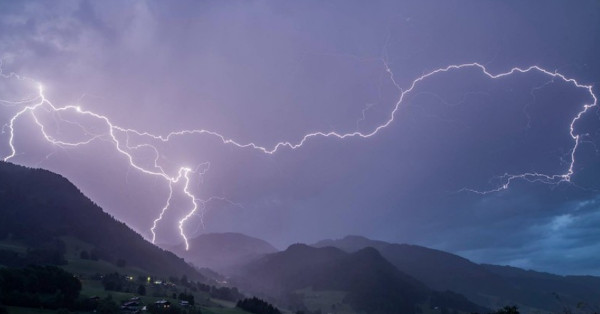
Une équipe de chercheurs des départements des géosciences, des sciences de l’atmosphère et des statistiques d’Innsbruck a constaté un doublement du nombre d’éclairs à haute altitudes dans les Alpes orientales au cours des 40 dernières années. Leur étude a été publiée dans la revue Climate Dynamics.
L’équipe scientifique d’Innsbruck a reconstitué avec une précision sans précédent l’activité de foudre entre les nuages et le sol dans les Alpes orientales de 1980 à 2019. Les chercheurs ont mis en relation deux sources d’information, toutes deux disponibles à une résolution spatio-temporelle de 32 km x 32 km et sur une durée d’une heure. À partir de ces ensembles de données, ils ont obtenu des informations sur l’activité de foudre grâce à des relevés continus au cours de la dernière décennie. Ils ont également eu accès à des analyses des conditions atmosphériques à une résolution horaire sur les quatre dernières décennies.
Les chercheurs ont constaté que les zones montagneuses, en raison de leur topographie, présentent des conditions favorables au développement des orages. Leurs analyses ont aussi montré que la hausse des températures due au réchauffement climatique entraîne une augmentation de la fréquence des orages et donc de la foudre.
Selon les scientifiques d’Innsbruck, les changements les plus significatifs se sont produits à haute altitude dans les Alpes entre 1980 et 2019. L’activité de foudre a doublé dans les années 2010 par rapport aux années 1980. Dans les zones de haute altitude dans les Alpes orientales, la saison d’orages accompagnés d’éclairs atteint un maximum plus important et commence un mois plus tôt. Pendant la journée, le pic peut être jusqu’à 50 % plus fort, avec plus d’éclairs l’après-midi et le soir.
L’examen approfondi des différents processus sur le terrain complexe des Alpes contribue de manière significative à la compréhension des relations entre la météo, le climat et la foudre. Ceci est important pour la mise en place de mesures préventives visant à protéger les personnes et l’environnement des dégâts potentiels causés par la foudre. .

Source : The Watchers ; Alps: Light­ning activ­ity dou­bled in a few decades – University of Innsbruck – June 20th, 2023.

————————————————

A team of researchers from the Departments of Geosciences, Atmospheric Sciences, and Statistics at Innsbruck has reported a doubling in the number of detected lightning strikes in the high altitudes of the European Eastern Alps over the last 40 years. Their study was published in the journal Climate Dynamics.

The Innsbruck team reconstructed the lightning activity of cloud-to-ground lightning in the area of the European Eastern Alps from 1980 to 2019 with unprecedented precision. The researchers linked two sources of information, both available at a spatio-temporal resolution of 32 km x 32 km and one hour. From these datasets they obtained information on lightning activity with seamless records over the last decade. They also accessed analyses of atmospheric conditions at an hourly resolution over the past four decades.

The researchers found that mountainous areas, due to their topography, have favorable conditions for the development of thunderstorms. Their analyses have now shown that the rising temperatures due to global warming are causing the frequency of thunderstorms and thus lightning to increase even further.

According to the Innsbruck scientists, the most intensive changes occurred in the high Alps between 1980 and 2019. Lightning activity doubled in the 2010s compared to the 1980s. In the high-altitude areas of the Eastern Alps, the lightning season reaches a stronger maximum and starts a month earlier. During the day, the peak is up to 50% stronger, with more lightning in the afternoon and evening.

The researchers’ comprehensive examination of different processes over the complex terrain of the Alps contributes significantly to understanding the relationships between weather, climate, and lightning activity. This is important for the appropriate development of preventive measures to protect people and the environment from the potential damage caused by lightning strikes. .

Source : The Watchers ; Alps: Light­ning activ­ity dou­bled in a few decades – University of Innsbruck – June 20th, 2023.
Crédit photo: Météo Samoens
L’éruption du Hunga Tonga-Hunga Ha’apai : un record d’éclairs // A record of lightning strikes

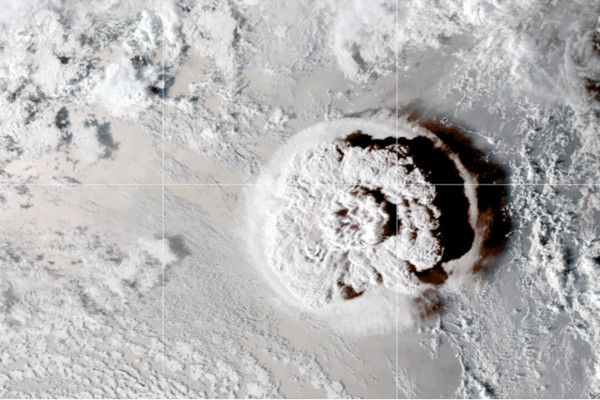
L’éruption du volcan sous-marin Hunga Tonga-Hunga Ha’apai en 2022 appartient au monde des superlatifs et des records. Elle a généré la plus puissante explosion atmosphérique jamais enregistrée. Elle a également produit un nombre record d’éclairs au cours d’un orage électrique qui a duré 11 heures et s’est étendu sur 240 kilomètres.
Dans une note publiée le 26 janvier 2023, j’écrivais que pour étudier les éclairs qui ont accompagné l’éruption, les scientifiques ont utilisé les données de GLD360, un réseau de détection de la foudre au sol. Ces données ont révélé que, sur les quelque 590 000 éclairs détectés pendant l’éruption, environ 400 000 se sont produits dans les six heures qui ont suivi la puissante explosion du 15 janvier.
Avant l’éruption du Hunga Tonga-Hunga Ha’apai, le plus grand événement de foudre volcanique s’est produit en Indonésie en 2018, lorsque l’Anak Krakatau est entré en éruption et a généré environ 340 000 éclairs en une semaine. Environ 56 % des éclairs produits par l’éruption des Tonga ont frappé la terre ou la surface de l’océan, et plus de 1 300 impacts ont été enregistrés sur Tongatapu, l’île principale des Tonga.
Une nouvelle étude publiée le 19 juin 2023 dans la revue Geophysical Research Letters nous donne plus de détails sur cet aspect de l’éruption. Nous apprenons que l’orage électrique a eu lieu à une altitude sans précédent de 20 à 30 kilomètres.
L’imagerie satellite montre que les éclairs n’étaient pas répartis au hasard dans le panache éruptif, mais qu’ils se produisaient en plusieurs anneaux concentriques qui semblaient liés à chaque phase explosive du volcan. En s’élevant, le panache a pris la forme d’un pin parasol. Ce phénomène a imprimé au nuage un mouvement vertical si important que l’onde a couvert 10 kilomètres en verticalité. Cette onde de pression oscillante, également connue sous le nom d’onde de gravité, est à l’origine de la foudre.
Les éclairs ont pu se former de deux manières différentes au sein de cette onde de gravité en forme d’anneau. L’éruption du Hunga Tonga s’étant déroulée sous l’eau, elle a injecté beaucoup d’eau dans l’atmosphère terrestre et les cristaux de glace qui en ont résulté ont adopté des charges positives et négatives. En outre, une partie des cendres volcaniques, formées de roches fragmentées et de magma projetées dans l’air par l’éruption, ont également été ionisées, ce qui a donné naissance à de nouvelles zones de charge positive et négative.
Si des anneaux de foudre ont déjà été observés dans des panaches volcaniques, l’éruption du Hunga Tonga a été la première à montrer des anneaux multiples (on en a compté quatre) et la foudre a glissé sur les ondulations des anneaux, comme un surfeur sur les vagues de l’océan.

Les anneaux de foudre sont également appelés « trous de foudre », car à l’intérieur de l’anneau, il n’y a généralement pas d’éclairs. L’éruption du Hunga Tonga est toutefois différente : les trous ont commencé à se remplir d’éclairs dans les minutes qui ont suivi le passage de l’onde de gravité. Le mécanisme à l’origine de ce remplissage n’a pas encore été élucidé par les chercheurs.
Outre le fait de battre des records, l’éruption du Hunga Tonga est susceptible de nous renseigner sur le volcanisme sur la Terre primitive, voire sur d’autres corps célestes. L’éruption est de type phréatoplinien, autrement dit elle se produit lorsqu’une énorme quantité de roche en fusion jaillit à travers une épaisse couche d’eau.
L’éruption pourrait aider à comprendre comment la foudre se déclenche sur d’autres planètes, telles que Vénus, ou d’autres corps planétaires qui ne sont pas le cadre de la foudre traditionnelle.
Source : Space.com.

——————————————–

The 2022 Hunga Tonga-Hunga Ha’apai volcanic eruption belongs to the world of superlatives. It produced the most powerful atmospheric explosion ever recorded. It also generated a record number of lightning strikes in a thunderstorm that lasted 11 hours and spread across 240 kilometers.

In a post released on January 26th, 2023, I wrote that to study the lightning that accompanied the eruption, the scientists used data from GLD360, a ground-based lightning detection network. This data revealed that, of the approximately 590,000 lightning strikes detected during the eruption, around 400,000 occurred within six hours that followed the powerful January 15th explosion.
Prior to the Hunga Tonga-Hunga Ha’apai eruption, the largest volcanic lightning event occurred in Indonesia in 2018, when Anak Krakatau erupted and generated around 340,000 lightning strikes in a week. About 56% of the lightning produced by the Tonga eruption struck the land or ocean surface, and more than 1,300 strikes were recorded on Tongatapu, the main island of Tonga.

A new research published on June 19th, 2023 in the journal Geophysical Research Letters gives us more details about tat aspect of the eruption. We learn that the lightning storm took place at an unprecedented altitude of between 20 and 30 kilometers.

The satellite imagery shows that the lightning was not randomly spread across the plume but rather occurred in several concentric rings that seemed to be linked to each explosive outburst from the volcano. As the plume rose upward, it formed an « umbrella cloud. » This imparted a vertical motion into the cloud so huge that the wave, moving outward from the center of the plume, was 10 vertical kilometers from crest to trough. This oscillating pressure wave, also known as a gravity wave, was the source of the lightning.

There are two ways the lightning may have formed within this ring-shaped gravity wave. Since the Hunga Tonga eruption took place underwater, it injected lots of water into Earth’s atmosphere, the resulting ice crystals adopting positive and negative charges. In addition, some of the volcanic ash that was formed of fragmented rock and magma blown into the air by the eruption also become ionized, leading to more areas of positive and negative charge. It is the gradient in electrical charge that sets off sudden sparks of lightning.

While lightning rings have been seen in volcanic plumes before, the Hunga Tonga eruption was the first time multiple rings (four of them) had been seen and the lightning rode the rippling rings like a surfer on ocean waves.

Lightning rings are also termed « lightning holes, » because inside the ring there usually is no lightning. However, the Hunga Tonga eruption was different: because the holes started filling with lightning within minutes of the gravity wave rippling by. The mechanism that prompted this infilling remains unclear.

Besides breaking records in the present day, the Hunga Tonga eruption could also teach us about volcanism on the early Earth, and even potentially on other celestial bodies. The eruption is a type referred to as phreatoplinian. It occurs when a huge amount of molten rock erupts through a thick layer of water.

The eruption could also have implications for the way that lightning gets going on other planets, such as Venus, or other planetary bodies that do not support traditional lightning.

Source : Space.com.

Source: NASA