Vortex polaire et réchauffement climatique // Polar vortex and global warming

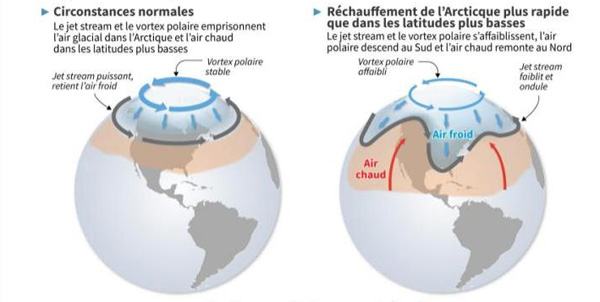
Plusieurs régions de l’hémisphère nord ont connu des vagues de froid ces dernières semaines. Aussi surprenant que cela puisse paraître, elles sont liées, elles aussi, au réchauffement climatique et son impact sur le vortex polaire. Comme je l’ai déjà expliqué, le vortex polaire est une zone de basses pressions en altitude engendrée par le manque d’ensoleillement plus marqué près des pôles géographiques terrestres. L’air froid y est ainsi plus dense, ce qui amincit l’atmosphère, créant une zone de basses pressions au niveau des pôles. Cette configuration engendre des vents – le jet stream ou courant jet – qui soufflent d’ouest en est.

En moyenne, le vortex polaire est centré sur le pôle géographique où il présente habituellement une température de -70 à -80 °C. Comme nous l’expliquait un jour Haroun Tazieff dans les années 1990, il peut toutefois arriver que le vortex polaire se déplace ou qu’il se divise en plusieurs morceaux qui peuvent alors migrer vers les latitudes plus basses. C’est ce qui se passe lorsqu’on observe un réchauffement stratosphérique soudain – Sudden Stratospheric Warming, SSW – qui se traduit par un fort réchauffement du vortex, qui peut alors présenter une température de l’ordre de 50 à 60 °C en quelques jours. Ce réchauffement peut faire se déplacer le vortex et entraîner une langue d’air froid vers les latitudes moyennes habituellement tempérées. La situation peut durer plusieurs jours, voire des semaines, entraînant une vague de froid sur une large partie de l’Europe.

Depuis 2015, j’ai écrit plusieurs notes sur le comportement du vortex polaire et ses « caprices ». Pour accéder à ces notes, il vous suffit de taper « vortex polaire » dans le moteur de recherche situé dans la colonne de droite du blog.

Source: Météo France

——————————————–

Several regions of the northern hemisphere have experienced cold spells in recent weeks. As surprising as it may seem, they are also linked to global warming and its impact on the polar vortex. As I have already explained, the polar vortex is a high altitude area of low pressure caused by the lack of sunlight that is more pronounced near the Earth’s geographic poles. The cold air is therefore denser, which thins the atmosphere, creating a zone of low pressure at the poles. This configuration generates winds – the jet stream – that blow from west to east.

On average, the polar vortex is centered on the geographic pole where it usually has a temperature of -70 to -80 °C. However, the polar vortex may move or split into several pieces that can then migrate to lower latitudes. This is what happens when there is a Sudden Stratospheric Warming, SSW, which results in a strong warming of the vortex, which can then have a temperature of around 50 to 60 °C in a few days. This warming can cause the vortex to move and send a tongue of cold air towards the usually temperate mid-latitudes. The situation can last for several days or even weeks, leading to a cold wave over a large part of Europe.
Since 2015, I have written several posts on the behavior of the polar vortex and its « whims ». To access these posts, simply type « polar vortex » in the search engine located in the right-hand column of the blog.

Nouveau réchauffement stratosphérique soudain // New sudden stratospheric warming

Un réchauffement stratosphérique soudain (en anglais Sudden Stratospheric Warming ou SSW) est un phénomène météorologique pendant lequel le vortex polaire dans l’hémisphère hivernal voit ses vents généralement d’ouest ralentir ou même s’inverser en quelques jours. Un tel phénomène va rendre le vortex plus sinueux, voire le rompre. Le changement est dû à une élévation de la température stratosphérique de plusieurs dizaines de degrés au-dessus du vortex. Elle grimpe très rapidement, passant de -70/-80°C à -10/-20°C degrés (soit une élévation d’une soixantaine de degrés en quelques jours).  Pour rappel, la stratosphère est la couche atmosphérique située au dessus de celle où nous vivons – la troposphère – à une altitude située entre 10 et 50 km environ.

Durant un hiver habituel dans l’hémisphère nord, plusieurs événements mineurs de réchauffement stratosphérique se produisent, avec un événement majeur environ tous les deux ans. Dans l’hémisphère sud, les SSW semblent moins fréquents et moins bien compris.

En conséquence, un réchauffement stratosphérique soudain et ses implications pour le vortex polaire peuvent avoir de sérieuses conséquences sur le climat de nos latitudes. L’air froid peut se retrouver piégé dans le jet stream (frontière entre l’air froid polaire et de l’air doux des tropiques) et être décalé jusqu’à nos latitudes, dans des régions peu habituées à un froid glacial, comme ce fut le cas en mars 2018 en Europe ou en février 2012 en France. Ces épisodes de SSW ne semblent toutefois pas avoir de relation avec le réchauffement climatique actuel ; ce sont de simples événements climatiques ponctuels.

°°°°°°°°°°

Les températures à haute altitude au-dessus du pôle Nord montent actuellement en flèche ; elles ont atteint 10°C en à peine une semaine. Ce réchauffement stratosphérique soudain perturbe le vortex polaire, ce qui pourrait avoir des conséquences importantes pour les conditions météorologiques dans l’hémisphère nord au mois de mars.
Cependant, le phénomène est encore mal compris et les scientifiques, bien qu’ils aient réussi à prévoir cet événement de réchauffement il y a deux semaines, disent qu’il est trop tôt pour savoir quel impact cela aura sur la météo dans les latitudes inférieures. Ces événements de réchauffement, qui se produisent en moyenne deux hivers sur trois, ne se déroulent pas toujours de la même manière.
Il se dit que l’événement actuel pourrait déclencher une réaction en chaîne qui chamboulerait les modèles météorologiques. Par exemple, l’est des États-Unis a connu des mois de janvier et de février exceptionnellement doux. Certains précédents réchauffements stratosphériques soudains accompagnés de perturbations du vortex polaire ont provoqué des vagues de froid extrêmes et de violentes tempêtes hivernales.
La dernière fois qu’un réchauffement stratosphérique soudain s’est produit, c’était le 5 janvier 2021. Un peu plus d’un mois plus tard, une vague d’air froid jamais vue depuis 1989 a plongé le centre des États-Unis dans une période de gel historique, provoquant la mise à l’arrêt du réseau électrique au Texas, un bilan de 330 morts, et plus de 27 milliards de dollars de dégâts.
Les scientifiques interrogés sur l’événement en cours disent qu’il est trop tôt pour savoir s’il déclenchera des conditions météorologiques extrêmes ou modifiera de manière significative les régimes météorologiques en cours dans l’hémisphère nord.

Les premiers jours du mois de mars s’annoncent froids en France, avec un épisode de vent de nord-nord-est d’une longueur inhabituelle. Reste à savoir si ces conditions météorologiques sont liées à un réchauffement stratosphérique soudain.

Source: Météo France,The Weather Channel.

En cliquant sur ce lien, vous aurez une très bonne explication (en anglais) du réchauffement stratosphérique soudain et du comportement du vortex polaire.

https://youtu.be/VnlFFaF_l7I

——————————————–

A Sudden Stratospheric Warming (SSW) is a meteorological phenomenon during which the polar vortex in the winter hemisphere sees its generally westerly winds slow down or even reverse within a few days. Such a phenomenon will make the vortex more sinuous, or even break it. The change is due to a rise of several tens of degrees in stratospheric temperature above the vortex. It climbs very quickly, going from -70 / -80 ° C to -10 / -20 ° C degrees (an increase of about sixty degrees in a few days). As a reminder, the stratosphere is the atmospheric layer located above the one where we live – the troposphere – at an altitude between 10 and 50 km approximately.

During a typical winter in the northern hemisphere, several minor stratospheric warming events occur, with one major event occurring approximately every two years. In the southern hemisphere, SSWs appear to be less frequent and less well understood.

As a result, sudden stratospheric warming and its implications for the polar vortex can have serious consequences for the climate of our latitudes. Cold air can get trapped in the jet stream (border between cold polar air and mild tropical air) and be shifted to our latitudes, in regions not used to freezing cold, like this was the case in March 2018 in Europe or in February 2012 in France. However, these episodes of SSW do not seem to have any relation to current global warming; they are simple one-off climatic events.

°°°°°°°°°°

Temperatures at the high altitudes above the North Pole are currently soaring, jumping up to 10°C in barely a week. This SSW is disturbing the polar vortex, which in turn could have major implications for weather patterns across the northern hemisphere in March.

However, the phenomenon is still poorly understood and scientists, despite successfully predicting this warming event two weeks ago, say it is too soon to know what it will mean for the weather in the lower latitudes. These events, which occur in two out of every three winters on average, don’t play out in a prescribed way.

There has been some speculation that the current event could trigger a chain reaction that would reshuffle weather patterns. For instance, the eastern U.S. has seen an exceptionally mild January and February and some previous sudden stratospheric warming and polar vortex disruptions have precipitated extreme cold snaps and severe winter storms.

The last time a sudden stratospheric warming event occurred was on January 5th, 2021. Just over a month later, the most dramatic cold air outbreak since 1989 plunged the central U.S. into a historic deep freeze, causing the collapse of Texas’s power grid, claiming at least 330 lives and incurring more than $27 billion in damages.

Multiple experts interviewed about the ongoing event say it’s too soon to know whether this one will trigger extreme weather or meaningfully change prevailing weather regimes over the northern hemisphere.

The first days of March are expected to be cold in France, with an unusually long episode of north-northeast winds. It remains to be seen whether these meteorological conditions are linked to a sudden stratospheric warming.

Source: Météo France,The Weather Channel.

By clicking on this link, you will get a very good explanation of the Sudden Stratospheric Warming and the behaviour of the polar vortex :

https://youtu.be/VnlFFaF_l7I
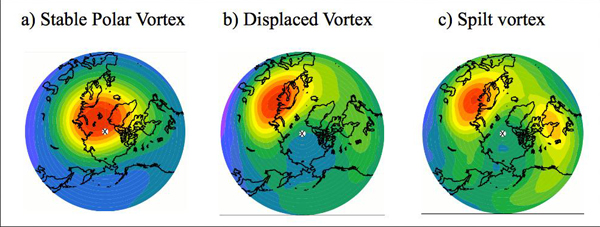
Variables de comportement du vortex polaire dans l’hémisphère nord : stable, décalé, rompu  (Source: Met Office)
Faut-il s’attendre à un réchauffement stratosphérique soudain ? // Should we expect a Sudden Stratospheric Warming ?

Un réchauffement stratosphérique soudain (en anglais Sudden Stratospheric Warming ou SSW) est un phénomène météorologique pendant lequel le vortex polaire dans l’hémisphère hivernal voit ses vents généralement d’ouest ralentir ou même s’inverser en quelques jours. Un tel phénomène va rendre le vortex plus sinueux, voire le rompre. Le changement est dû à une élévation de la température stratosphérique de plusieurs dizaines de degrés au-dessus du vortex. Elle grimpe très rapidement, passant de -70/-80°C à -10/-20°C degrés (soit une élévation d’une soixantaine de degrés en quelques jours).  Pour rappel, la stratosphère est le couche atmosphérique située au dessus de celle où nous vivons – la troposphère – à une altitude située entre 10 et 50 km environ.

Durant un hiver habituel dans l’hémisphère nord, plusieurs événements de réchauffement mineur stratosphérique se produisent, avec un événement majeur se produisant environ tous les deux ans. Dans l’hémisphère sud, les SSW semblent moins fréquents et moins bien compris.

En conséquence, un réchauffement stratosphérique soudain et ses implications pour le vortex polaire peuvent avoir de sérieuses conséquences sur le climat de nos latitudes. L’air froid peut se retrouver piégé dans le jet stream (frontière entre l’air froid polaire et de l’air doux des tropiques) et être décalé jusqu’à nos latitudes, dans des régions peu habituées à un froid glacial, comme ce fut le cas en mars 2018 en Europe ou en février 2012 en France. Ces épisodes de SSW ne semblent toutefois pas avoir de relation avec le réchauffement climatique actuel ; ce sont de simples événements climatiques ponctuels.

Selon les météorologistes, il semble qu’un réchauffement stratosphérique soudain soit en préparation actuellement, avec un impact sur les conditions climatiques de l’hémisphère nord vers la mi-janvier avec l’arrivée d’un temps sec mais particulièrement froid à cause du blocage des hautes pressions par le vortex. Selon les météorologues, ces conditions froides devraient surtout affecter l’Europe du Nord et le Royaume Uni, alors que les conditions climatiques seront plus douces, humides et venteuses dans le sud de l’Europe.

La France devrait donc se trouver dans la zone tampon, avec des températures certes plus froides, mais pas extrêmement basses. De telles conditions semblent favorables à des chutes de neige.

Ces prévisions demandent toutefois confirmation et sont en grande partie régies par le comportement du vortex polaire, selon qu’il reste uniforme ou se brise en plusieurs morceaux.

Source: Météo France,The Weather Channel, The Watchers.

En cliquant sur ce lien, vous aurez une très bonne explication (en anglais) du réchauffement stratosphérique soudain et du comportement du vortex polaire.

https://youtu.be/VnlFFaF_l7I

————————————————

 A Sudden Stratospheric Warming (SSW) is a meteorological phenomenon during which the polar vortex in the winter hemisphere sees its generally westerly winds slow down or even reverse within a few days. Such a phenomenon will make the vortex more sinuous, or even break it. The change is due to a rise of several tens of degrees in stratospheric temperature above the vortex. It climbs very quickly, going from -70 / -80 ° C to -10 / -20 ° C degrees (an increase of about sixty degrees in a few days). As a reminder, the stratosphere is the atmospheric layer located above the one where we live – the troposphere – at an altitude between 10 and 50 km approximately.

During a typical winter in the northern hemisphere, several minor stratospheric warming events occur, with one major event occurring approximately every two years. In the southern hemisphere, SSWs appear to be less frequent and less well understood.

As a result, sudden stratospheric warming and its implications for the polar vortex can have serious consequences for the climate of our latitudes. Cold air can get trapped in the jet stream (border between cold polar air and mild tropical air) and be shifted to our latitudes, in regions not used to freezing cold, like this was the case in March 2018 in Europe or in February 2012 in France. However, these episodes of SSW do not seem to have any relation to current global warming; they are simple one-off climatic events.

According to meteorologists, it seems that a sudden stratospheric warming is in preparation now, with an impact on the weather conditions of the northern hemisphere around mid-January with the onset of dry but particularly cold weather due to the blockage of high pressures by the vortex. According to meteorologists, these cold conditions should mainly affect northern Europe and the United Kingdom, while the weather will be milder, wetter and windy in southern Europe. France should therefore be in the buffer zone, with temperatures certainly colder, but not extremely low. Such conditions seem favorable for snowfall.

These predictions require confirmation, however, and are largely governed by the behaviour of the polar vortex, whether it remains uniform or shatters into several pieces.

Source: Météo France,The Weather Channel, The Watchers.

By clicking on this link, you will get a very good explanation of the Sudden Stratospheric Warming and the behaviour of the polar vortex :

https://youtu.be/VnlFFaF_l7I

 Variables de comportement du vortex polaire dans l’hémisphère nord : stable, décalé, rompu  (Source: Met Office)

Nouveau réchauffement stratosphérique soudain ? // New Sudden Stratospheric Warming ?

Souvenez-vous : une vague de froid extrême s’est abattue sur le nord des Etats-Unis au cours du mois de janvier 2019, avec des températures qui sont descendues jusqu’à -40°C dans certaines villes. On a expliqué le phénomène par l’air glacial qui s’était échappé du vortex polaire.

Le vortex polaire est un vaste courant d’air qui entoure les régions polaires de l’hémisphère nord. Le moteur de ce courant est constitué par des vents qui tournent dans le sens inverse des aiguilles d’une montre, d’est en ouest. Cette circulation rapide permet en temps normal de maintenir l’air froid à des latitudes élevées près du pôle.

Toutefois, il arrive que le vortex se disloque et laisse échapper des bulles d’air froid qui descendent alors à des latitudes plus basses. C’est ce qui s’est passé en janvier 2019. Toutefois,  cet air froid ne s’est pas propagé partout : alors qu’il faisait très froid dans certaines parties du Canada, dans le Midwest des Etats Unis et en Sibérie centrale, l’Alaska connaissait un hiver remarquablement doux avec des records de chaleur.

La dislocation du vortex polaire n’est pas un phénomène rare. Un processus similaire a été observé en 2014 et en 2018. Avec janvier 2019, on observe cependant une répétition anormale du phénomène. .

Ces perturbations subies par le vortex polaires sont liées à un réchauffement soudain au niveau de la stratosphère. C’est ce que l’on appelle le réchauffement stratosphérique soudain. Durant l’hiver, il arrive parfois qu’à cette altitude la température grimpe rapidement, jusqu’à gagner 50°C en quelques jours, et cette forte hausse a pour effet de modifier la circulation des vents autour du vortex polaire. En conséquence, ce dernier peut se fragmenter et laisser échapper de l’air froid vers des latitudes plus basses. Le phénomène va alors se propager de la stratosphère jusqu’à la  troposphère en dessous et affecter d’autres processus comme le jet-stream, courant d’air très rapide situé à 8-12 kilomètres d’altitude et qui délimite les masses d’air.

 Ces derniers jours, les prévisions météorologiques laissent entendre qu’un nouveau réchauffement stratosphérique soudain pourrait se produire dans les prochaines semaines, avec affaissement du vortex polaire et une vague de froid sévère dans certaines régions de l’hémisphère nord. Cette prévision devra être confirmée.

++++++++++

Le célèbre aventurier sud-africain Mike Horn, accompagné par l’explorateur polaire norvégien Børge Ousland, connaissent actuellement les pires difficultés pour progresser sur la banquise arctique. Après avoir été déposés il y a deux mois par le voilier de Mike Horn, les deux baroudeurs ont entrepris de parcourir 1600 km de glace en skis de randonnée en franchissant le pôle Nord au passage, objectif qu’ils ont atteint le 17 octobre dernier.

Sous l’effet du réchauffement climatique particulièrement intense dans les hautes latitudes, la glace se brise et se déplace beaucoup plus vite qu’auparavant. Les hommes sont tombés à l’eau à plusieurs reprises. Mike Horn a déclaré : « C’est triste à admettre pour moi, mais de toutes mes années en tant qu’explorateur professionnel, je n’ai jamais été aussi affecté par les changements climatiques.»

——————————————————

Remember: an extreme cold snap hit the northern United States during January 2019, with temperatures down to -40°C in some cities. The phenomenon was explained by icy air that had escaped from the polar vortex.
The polar vortex is a vast stream of air that surrounds the polar regions of the northern hemisphere. The engine of this current consists of winds that rotate anticlockwise, from east to west. This rapid circulation normally allows cold air to be maintained at high latitudes close to the Pole.
However, the vortex may break up and let out cold air bubbles that then descend to lower latitudes. This is what happened in January 2019. However, this cold air did not spread everywhere: while it was very cold in parts of Canada, in Midwestern United States and Central Siberia, Alaska had a remarkably mild winter with records of heat.
The dislocation of the polar vortex is not a rare phenomenon. A similar process was observed in 2014 and 2018. With January 2019, however, there is an abnormal repetition of the phenomenon. .
These disturbances to the polar vortex are related to a sudden warming in the stratosphere. This is called Sudden Stratospheric Warming (SSW). During the winter, temperatures may rise very rapidly at this altitude and increase by as much as 50 degrees Celsius in a few days. This strong increase alters the circulation of the winds around the polar vortex. As a result, it can fragment and let cold air escape to lower latitudes. The phenomenon will then spread from the stratosphere to the troposphere below and affect other processes such as the jet-stream, a very fast airflow located 8-12 kilometres above sea level and which delimits the masses of air.

The latest forecast models suggest a major stratospheric warming event might develop in the next weeks, possibly initiating a collapse sequence of the polar vortex and severe cold snaps in some regions of the northern hemisphere. This forecast will have to be confirmed.

++++++++++

Mike Horn, the famous South African adventurer, accompanied by the Norwegian polar explorer Børge Ousland, is currently experiencing the worst difficulties to progress on the Arctic sea ice. After having been dropped two months ago by Mike Horn’s sailboat, the two men set out to cover 1600 km of ice on cross-country skis while sliding past the North Pole, which they reached on October 17th.
Due to the fact that global warming is particularly intense in high latitudes, the ice breaks up and moves much faster than before. The men fell in the water several times. Mike Horn said, “It’s sad to admit for me, but in all my years as a professional explorer, I’ve never been so affected by climate change.”

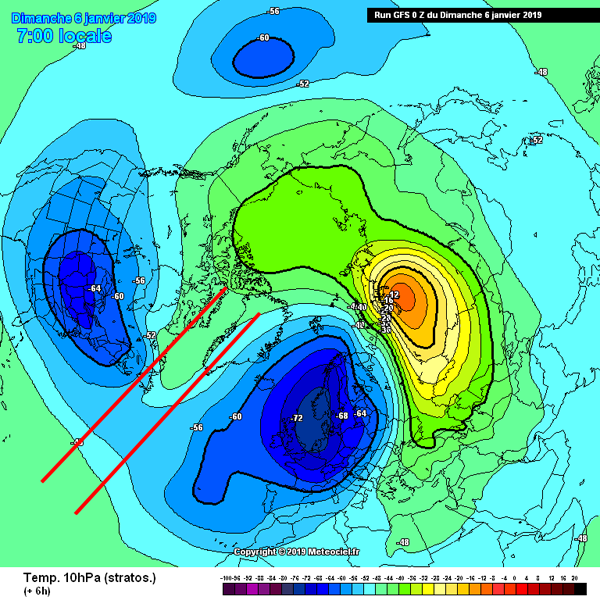
A titre d’exemple, cette carte météo de janvier 2019 montre la position des masses d’air. On note une nappe de  réchauffement au-dessus de la Russie où la température est passée de – 70°C à – 10°C.  Une telle situation peut affecter le vortex se polaire et le faire se disloquer, avec des vagues de froid dans les basses latitudes. (Source: Météo France)