 Dans une note rédigée le 8 septembre 2013, j’indiquais que, selon une étude effectuée par des scientifiques de plusieurs universités américaines, le plus grand volcan du monde se trouvait sous l’Océan Pacifique. Appelé Massif Tamu, il est beaucoup plus grand que le Mauna Loa à Hawaii et n’est que de 25% inférieur à Olympus Mons sur Mars, le plus grand volcan du système solaire. Le Tamu présente une envergure de 650 kilomètres et une hauteur d’environ 4 km. Il est entré en éruption pendant quelques millions d’années pendant les premières années du Crétacé, il y a environ 144 millions d’années et il est resté inactif depuis cette époque.
Une équipe scientifique du Schmidt Ocean Institute vient de terminer la cartographie du Tamu. A bord du navire de recherches Falkor, les chercheurs ont réussi à réaliser une carte couvrant 98% de la zone tout en rassemblant 2 millions de mesures magnétiques qui devraient permettre d’en savoir plus sur la formation du volcan.
———————————–
 In a note written on September 8th 2013, I indicated that according to research by scientists from several U.S. universities, the world’s largest volcano lay beneath the Pacific Ocean. Called the Tamu Massif, it is much bigger than Hawaii’s Mauna Loa and is only 25 percent smaller than Olympus Mons on Mars which is the biggest volcano in Earth’s solar system.
Tamu is 650 kilometres wide and about 4 km tall. It erupted for a few million years during the early Cretaceous period, about 144 million years ago, and has been extinct since then.
A scientific team with the Schmidt Ocean Institute has just finished mapping the Tamu volcano. The researchers aboard the Falkor research vessel were able to map about 98% of the area – filling in gaps of information about the geography of the volcano while collecting almost 2 million magnetic measurements which help to better understand how the volcano was formed.
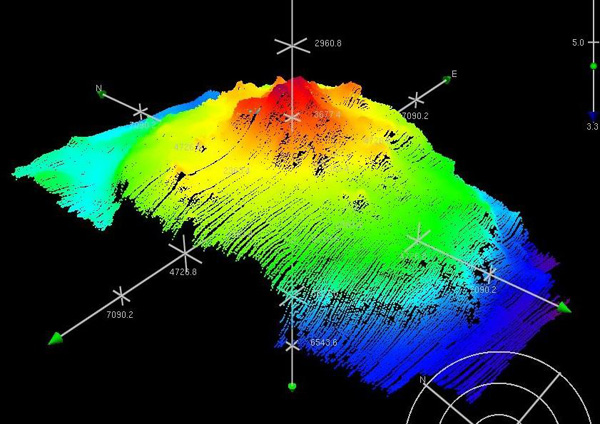
Source: Schmidt Ocean Institute
 Claude Grandpey : Volcans et Glaciers