Depuis l’éruption de l’Eyjafjöll en 2010 et la panique générale qu’elle a déclenchée dans le trafic aérien en Europe, les chercheurs essayent de trouver des solutions pour que pareille mésaventure ne se reproduise pas. On a beaucoup parlé (et, me concernant, émis des réserves !) d’un système embarqué à bord des avions et qui serait capable de détecter la densité des nuages de cendre. La revue Nature Geoscience nous apprend aujourd’hui que le GPS pourrait permettre d’évaluer la hauteur du panache éruptif et donc, lui aussi, apporter des solutions aux problèmes rencontrés par le trafic aérien en cas d’éruption.
Ce sont des volcanologues islandais qui font part de cette information. Cette fois, ce n’est pas l’Eyjafjöll qui est concerné, mais le Grimsvötn, un volcan qui se cache sous la glace du Vatnajökull. Il est entré en éruption en 2011, avec un panache de cendre de 20 km de hauteur qui a perturbé le trafic aérien au Royaume Uni.
Selon les scientifiques islandais, le GPS aurait un double avantage : il permettrait non seulement de prévoir les éruptions, mais aussi de déterminer la hauteur du panache de cendre qu’elles génèrent.
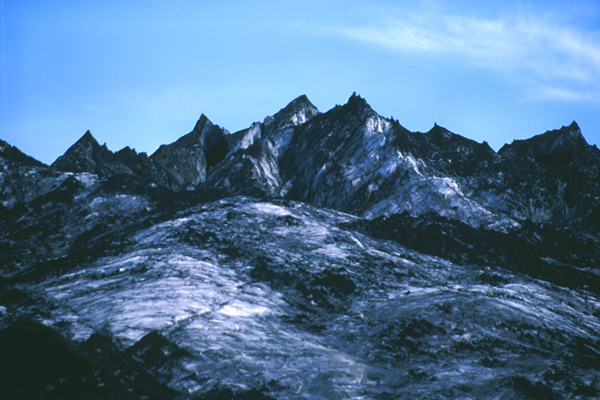
L’univers de glace du Grimsvötn rend difficile l’installation d’instruments de mesure. Par chance, les volcanologues islandais avaient pu placer un équipement GPS sur un petit éperon rocheux rendu accessible grâce à une fumerolle. Une heure avant l’éruption du Grimsvötn en 2011, le GPS a révélé un déplacement significatif du sol de plus de 50 centimètres. En mettant en oeuvre les équations qui décrivent les caractéristiques physiques d’une chambre magmatique, les scientifiques ont traduit les données GPS sur les mouvements du sol en variations de pression à l’intérieur de la chambre. Le résultat donnait une indication sur la hauteur probable du panache éruptif. Les volcanologues islandais comparent le phénomène à un ballon qui serait rempli d’eau. Quand on comprime ses parois, l’eau jaillit et la hauteur du jet dépend de la pression exercée sur les parois du ballon. Dans le cas d’un volcan, les sismographes indiquent qu’une éruption est susceptible de se produire, mais seul le GPS est capable de donner une idée de la taille de l’éruption.
L’installation de balises GPS sur des volcans difficiles d’accès, comme ceux des Iles Aléoutiennes par exemple, pourraient donner des indications sur la hauteur des panaches de cendre dans une région empruntée par les vols entre l’Amérique et l’Asie. Le principal problème reste le coût d’installation de stations GPS performantes à une époque où les fonds alloués aux observatoires rétrécissent comme peau de chagrin. De plus, il faudrait tester à nouveau le système lors d’une prochaine éruption pour s’assurer de sa fiabilité.
 Since the eruption of Eyjafjöll in 2010 and the panic it triggered in European air traffic, researchers have tried to find solutions to avoid a similar mishap. Many comments (and reservations, as far as I’m concerned!) have been made about a system on board the planes that would be able to detect the density of the ash clouds. When reading the Nature Geoscience review, we learn that GPS could help estimate the height of the ash plume and, as such, bring solutions to the problems encountered by air traffic during an eruption.
The piece of news comes from Icelandic scientists. In their opinion, GPS might have a dual advantage: It would not only allow to predict eruptions, but also the height of the ash plumes they generate.
The icy universe of Grimsvötn makes it difficult to set up measuring instruments. Fortunately, Icelandic volcanologists had managed to install a GPS system on a rocky outcrop that was made accessible thanks to a fumarole. One hour before the start of the 2011 eruption, GPS had revealed a significant shift of the ground which had moved by more than 50 centimetres. By resorting to the equations that describe the physical characteristics of a magma chamber, the scientists could translate the GPS data about ground movement into changes in pressure inside the chamber. The results gave indications about the height of the eruptive plume. Icelandic volcanologists compare this phenomenon with a balloon filled with water. When you squeeze the walls of the balloon, then the height of the water coming out of the balloon correlates with how hard you were squeezing. On a volcano, seismographs indicate that an eruption is likely to happen, but the GPS system is the only one able to give an idea of the size of the eruption.
Setting up GPS systems on remote volcanoes like on the Aleutians could help indicate the height of the ash plumes in an area where air traffic between America and Asia is quite heavy. The main problem remains the cost of installing reliable GPS systems at a time when the funds allocated to observatories are being reduced year after year. Moreover, the system will need to be tested again during a future eruption so as to confirm its reliability.

Image satellite du Grimsvötn le 22 mai 2011 (Crédit photo: NASA)