 Le 2 mars 2024, la plupart des volcanologues islandais pensaient qu’une éruption était imminente en raison de la quantité de magma qui s’était accumulée au niveau de l’intrusion. Le volume avait dépassé cekui qui avait provoqué la dernière éruption. La péninsule de Reykjanes a été mise en état d’alerte ; Grindavík et le Blue Lagoon ont été évacués. Les trois principales routes d’accès à Grindavík, la Grindarvíkurvegur, la Nesvegur et la Suðurstrandarvegur ont également été fermées. Les ouvriers étaient en alerte avec des bulldozers et des pelleteuses, prêts à combler les trous ménagés pour permettre aux routes de traverses les digues de terre. Le Met Office islandais a annoncé que la probabilité d’une éruption était très élevée, peut-être dans quelques heures, voire quelques minutes.
À 17h30, le Met Office a annoncé qu’un intense essaim sismique était enregistré à l’est de Sýlingarfell et qu’une éruption fissurale était probable. La sismicité se déplaçait vers le sud en direction de Hagafell, mais les mesures GPS montraient moins de déformation du sol qu’avant les éruptions précédentes.
Plus tard dans la soirée, le Met Office a annoncé que la sismicité avait cessé et que l’intrusion magmatique s’était probablement arrêtée temporairement. Des déformations mineures ont continué à être mesurées dans la zone, de sorte que le Met Office n’a pas voulu indiquer que l’intrusion était terminée, même s’il ne semblait pas que le magma se déplaçait vers la surface.
Les volcanologues islandais pensent qu’une nouvelle intrusion magmatique s’est probablement formée entre Sýlingarfell et Hagafell, ce qui a provoqué une chute de pression. La probabilité d’une éruption imminente a donc diminué, du moins pour le moment, mais la probabilité d’une nouvelle éruption reste élevée.
Une fois de plus, cette situation montre la fragilité de la prévision volcanique. Aucune éruption ne s’est produite au cours du week-end, comme l’avait prédit un chercheur de l’Université d’Islande. Le problème est que l’éruption prévue depuis plusieurs jours n’aura pas lieu dans une zone désertique. Elle pourrait vite devenir une menace pour une zone habitée et pour des infrastructures essentielles. Il ne reste plus qu’à attendre la suite des événements…
Source : Moniteur d’Islande.
Aucun événement sismique significatif n’a été détecté durant le week-end et la situation est très calme ce lundi matin. Cependant, tout le monde sait que les choses peuvent changer rapidement.
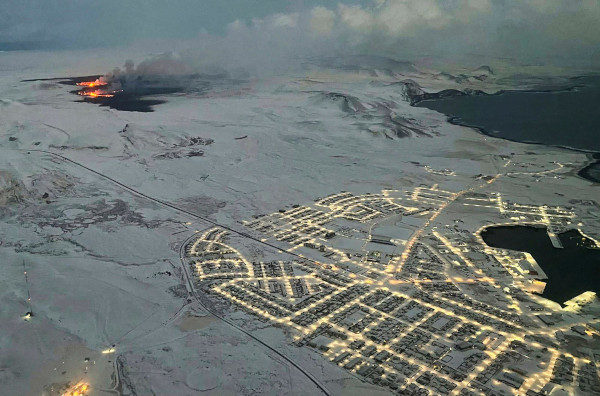
Grindavik reste sous la menace de la lave (Crédit photo: Iceland Review)
————————————————–
 On March 2nd, 2024, most specialists in volcanology thought that an eruption was pending due to the amount of magma accumulated in the magma channel, which had exceeded the amount that caused the last eruption to occur. Everything went on high alert and both Grindavík and the Blue Lagoon were evacuated. The three main access roads to Grindavík, Grindarvíkurvegur, Nesvegur and Suðurstrandarvegur were also closed. Workers were standing on alert with pushers and excavators, ready to fill in holes where roads run through the defenses.The Icelandic Met Office announced that the likelihood of an eruption was very high, and possibly within hours, if not minutes.
At 17:30 the Icelandic Met Office announced that an intense swarm of microseismic activity was occurring east of Sýlingarfell and that a fissure eruption was likely. The seismicity was moving south toward Hagafell but GPS-based measurements showed fewer signs of deformation than before previous eruptions.
Later in the evening, the Icelandic Met Office announced that the seismicity had ceased, and that the magma intrusion had probably stopped temporarily. Minor deformation continued to be measured in the area, so the Met Office did not want to issue a statement that the magma intrusion had ended, although it did not seem like the magma would be propagating to the surface.
Icelandic volcanologists think that a new magma channel probably formed, stretching between Sýlingarfell and Hagafell, which had decreased the pressure. Therefore the likelihood of a pending eruption diminished, at least for now. However, the likelihood of another eruption is still high.
Once again, this situation shows the fragility of volcanic prediction. An eruption did not occur during the weekend, as predicted by a University of Iceland researcher. The problem is that the likely eruption will not take place in a desert area. It might soon become a threat to a populated area and to essential infrastructure. Let’s see what happens next.
Source : Iceland Monitor.
No significant seismic event has been detected during the weekend and the situation is very quiet this Monday morning. However, evrybody knows that things may change rapidly.
 Claude Grandpey : Volcans et Glaciers