 Partout dans le monde, les glaciers fondent à cause du réchauffement climatique. Cependant, certains d’entre eux semblaient faire de la résistance et être insensibles à la hausse des températures. Le Perito Moreno, situé dans le champ de glace sud de la Patagonie argentine, en faisait partie. On pensait que ce glacier était l’un des rares sur Terre à être relativement stable. Ce n’est plus le cas et le Perito Moreno connaît actuellement son « recul le plus important depuis le siècle dernier », selon une nouvelle étude publiée dans la revue Communications Earth & Environment.
Le Perito Moreno a commencé à perdre contact avec le substrat rocheux, ce qui entraîne une augmentation de la perte de glace à mesure qu’il recule. Un phénomène, par ailleurs observé au Groenland, se produit sur le glacier : de petits lacs d’eau de fonte sont apparus à sa surface. Avec le temps, cette eau s’est infiltrée à l’intérieur du glacier et a atteint le substrat rocheux où elle se comporte comme un lubrifiant, accélérant la vitesse du glacier qui, dans le même temps, perd de son épaisseur. .Ce changement, illustré par des vidéos en accéléré spectaculaires depuis 2020, met en évidence l’équilibre fragile de l’un des glaciers les plus connus au monde.
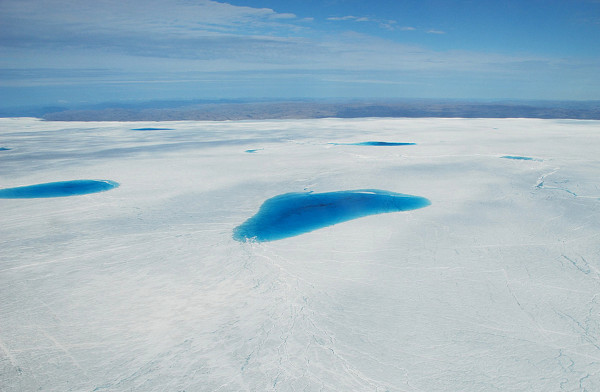
Lacs de fonte au Groenland
Les auteurs de l’étude prévoient que le Perito Moreno reculera encore de plusieurs kilomètres au cours des prochaines années. Ils ont mené des travaux de terrain afin d’obtenir les données nécessaires à leurs calculs. Pour mesurer l’épaisseur de la glace, ils ont survolé le glacier en hélicoptère avec un radar suspendu sous l’appareil. Ils ont également utilisé un sonar sur le lac Argentino et des données satellitaires.
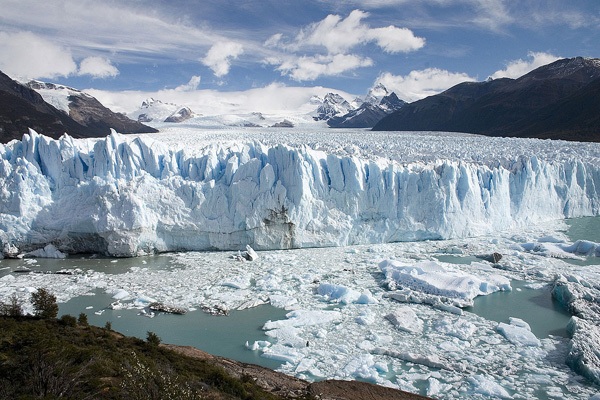
Chaque année, des centaines de milliers de personnes visitent le glacier Perito Moreno, inscrit au patrimoine mondial de l’UNESCO en 1981. Ce site est connu pour le vêlage d’énormes blocs de glace qui s’écroulent dans le lac Argentino de manière très spectaculaire.
Les négationnistes du réchauffement climatique pointent souvent du doigt des anomalies comme la résistance du Perito Moreno, qui, pendant longtemps, n’a pas reculé contrairement à la plupart des autres glaciers de la planète. Même sans réchauffement climatique, les glaciers fluctuent légèrement. Si le climat est stable, l’accumulation de neige et de glace en amont compense la fonte en aval. Malheureusement, l’accumulation de neige dans la partie supérieure du glacier est devenue insuffisante pour favoriser sa progression.
Au final, le Perito Moreno ne diffère plus des autres glaciers : il fond et recule.
Source : Associated Press via Yahoo News.
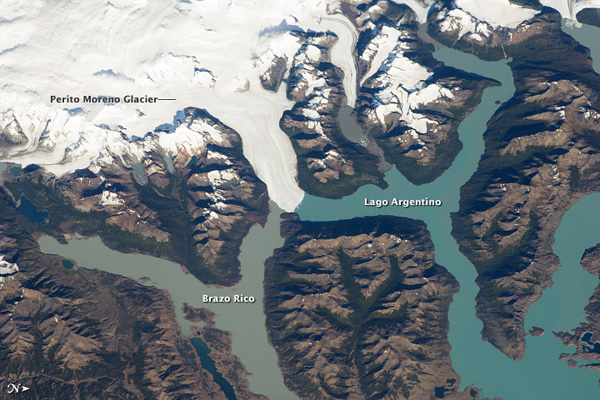
Source: Wikipedia
————————————————–
 Glaciers are melting all over the world because of global warming. However, it seemed a few of them were resilient and unaffected by the rising temperatures. Perito Moreno in Argentina’s Southern Patagonian Ice Field was one of them. The glacier was thought to be one of the few on Earth to be relatively stable. This is no longer true and Perito Moreno is now undergoing its “most substantial retreat in the past century,” according to new research releaszed in the journal Communications Earth & Environment.
Perito Moreno has started losing contact with the bedrock below, causing it to shed more ice as it inches backward. A phenomenon, already observed in Greenland has occurred at Perito Moreno. Small meltwater lakes have appeared on the glacier’s surface. With time, this water percolates into the glacier and reaches the beadrock where it acts as a lubricant, accelerating the speed of the glacier which loses thickness in the meantime. It’s a change, illustrated in dramatic timelapse photos since 2020, that highlights the fragile balance of one of the most well-known glaciers worldwide.
The authors of the study expect Perito Moreno to retreat several more kilometers in the next few years. They did extensive field work to get the data for their calculations. To measure ice thickness, they flew over the glacier in a helicopter with a radar device suspended beneath. They also used sonar on Lake Argentino and satellite information from above.
Every year, hundreds of thousands of people visit Glaciar Perito Moreno, which was declared a UNESCO World Heritage Site in 1981. It’s a site known to “calve” ice chunks that fall into Lake Argentino.
People who deny global warming frequently point to anomalies like Perito Moreno, which for a long time was not retreating when most other glaciers were. Even without global warming, glaciers fluctuate a bit. If the climate is stable, ordinary accumulation of snow and ice offsets the melting. Unfortunately, snow accumulation in the upper part of the glacier is insufficient to help the glacier move forward.
Another phenomenon has been observed at Perito Moreno. Small meltwater lakes have appeared on the glacier’s surface. With time, this water percolates into the glacier and reaches the beadrock where it acts as a libricant, accelerating the speed of the glacier which loses thickness in the meantime.
In the end, Perito Moreno is no longer different fromthe other glaciers : it is melting and retreating.
Source : Associated Press via Yahoo News.
 Claude Grandpey : Volcans et Glaciers