 L’arrivée d’un ours en Islande, en provenance du Groenland, est un événement exceptionnel, mais il arrive que des plantigrades débarquent dans le nord-ouest de l’île, transportés par de petits icebergs qui se sont détachés de la banquise.
Un ours, probablement un jeune animal, a été observé sur une plage dans le Jökulfjörður et les autorités islandaises ont immédiatement décidé de l’abattre pour assurer la sécurité de la population de Höfðaströnd, où un homme vit actuellement dans une maison d’été.
La police a déclaré que c’était le seul moyen d’assurer la sécurité de la zone. « Les ours polaires sont dangereux. Personne ne va transporter de tels animaux vivants dans un hélicoptère ou un bateau. De plus, l’Agence de l’Environnement ne dispose pas du matériel nécessaire pour capturer des animaux vivants, il n’y avait donc pas d’autre solution que de tuer l’ours. »
Interrogée sur le sort de la carcasse de l’animal, la police a déclaré qu’elle sera transportée à Reykjavik où un laboratoire spécialisé l’examinera et prélèvera des échantillons. Il faudra être vigilant car les ours sont connus pour véhiculer des bactéries qui peuvent être dangereuses pour l ‘homme. L’ours peut aussi être porteur de la rage et de la grippe aviaire. Un échantillon d’ADN permettra de savoir à quelle population du Groenland il appartient.
Beaucoup d’Islandais sont très mécontents quand des ours polaires sont abattus. Un policier a déclaré qu’il doit débrancher son téléphone la nuit car les gens appellent pour demander de ne pas tuer les ours et les laisser partir.
Les autorités islandaises ont contacté un vétérinaire du Groenland lorsque l’ours a été vu pour la première fois sur la plage, mais le vétérinaire a dit que les Groenlandais n’en voulaient pas parce qu’ils ont assez d’animaux.
Une tentative a déjà été effectuée pour sauver un ours polaire qui avait débarqué en Islande en 2008, mais elle n’a pas abouti. Un chercheur de l’Institut d’histoire naturelle a expliqué que « tout avait été fait pour l’éloigner, un navire avait même été prévu, mais les Groenlandais ont simplement dit « Non, nous ne l’acceptons pas. Il peut s’agir d’un animal malade ».
Source : Iceland Monitor.
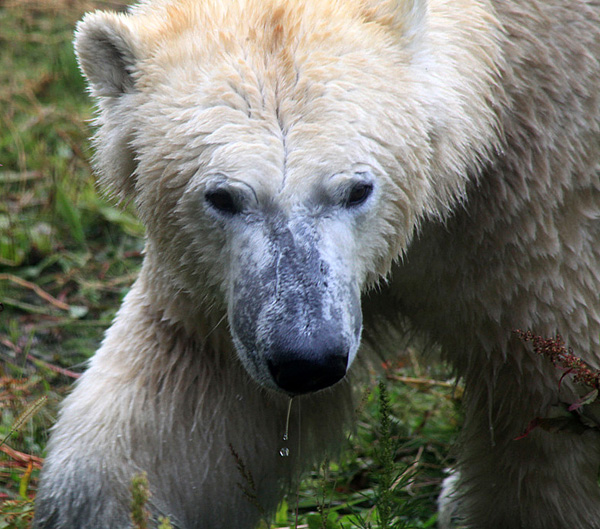
Photo: C. Grandpey
———————————————
 The arrival of a polar bear in Iceland is an exceptional event, but animals from Greenland may land in northwest Iceland, carried by small icebergs that detached from Greenland’s sea ice. One of them, probably a young animal, was observed on a beach in Iceland’s Jökulfjörður in the Westfjords, and Icelandic authorities decided to kill it to ensure the safety of people at Höfðaströnd where one adult lives in a summer house.
The police said this was the only way to do ensure the safety of the area. « Polar bears are dangerous. No one is going to take such animals alive in a helicopter or boat. Moreover, the Environment Agency does not have the equipment needed to capture animals alive, so there was no other resources than to kill the bear. »
Asked what will happen to the carcass of the animal, the police said it will be transported to Reykjavík where a natural science laboratory will examine it and take samples. Various things will be checked because the bears are known for being exposed to bacteria that can be dangerous to humans. The bear can carry rabies and bird flu. A DNA sample will also allow to know which of the Greenland population it is.
Many people in Iceland get very angry when polar bears are shot. A policeman said he usually has to unplug the phone at night because people call to ask not to shoot the bears but to let them go.
Icelandic authorities talked to a vet in Greenland when the bear was first seen on the beach, but the vet said that they didn’t want him at all because they have enough animals.
An attempt was already made to save a polar bear that landed in Iceland in 2008, but that it was unsuccessful. A researcher at the Natural History Institute of Iceland explained that « everything was supposed to be done to get it away, a guard ship was waiting outside and everything, but the Greenlanders just said « No, we do not accept this. It can be a sick animal’. »
Source : Iceland Monitor.
 Claude Grandpey : Volcans et Glaciers