
 Les ours polaires ne sont généralement pas présents dans le sud ou l’ouest du Groenland, mais 2024 fait exception à la règle. Cette année, on rencontre les plantigrades partout dans l’ouest du Groenland. Deux d’entre eux ont récemment été observés près de Nuuk, la capitale. Un certain nombre d’ours se sont également approchés très près des villes du sud du Groenland cet été. Plusieurs ours polaires ont été abattus à Qaqortoq après evoir pénétré carrément dans la ville. Ce n’est pas bon signe. Cela signifie que les animaux ne trouvent plus assez de nourriture dans l’océan. 68 ours polaires avaient déjà été vus au début de l’année dans l’est du Groenland, en train de faire un festin sur une carcasse de baleine. Une autre raison de la présence inhabituelle d’ours polaires dans certaines parties du Groenland est la présence d’une vaste superficie de banquise cette année. La glace de mer descend vers l’est du Groenland avant de contourner la pointe sud et de remonter vers le nord avec les courants marins. C’est ce qui explique la présence des ours à Qaqortoq, Nuuq et ailleurs.
Deux ours polaires ont même été vus sur le populaire sentier du cercle polaire arctique (Arctic Circle Trail) de 160 km entre Kangerlussuaq et Sisimiut. Comme les ours sont rares dans cette partie de l’Arctique, les randonneurs et les habitants ne portent pas d’armes à feu. Plusieurs randonneurs ont annulé leurs plans de randonnée en raison de la menace potentielle des ours. A noter que l’évacuation par hélicoptère sous prétexte que vous avez simplement aperçu un ours polaire n’est probablement pas couvert par votre assurance.
Un Allemand qui faisait partie d’une équipe scientifique a été attaqué par un ours polaire dans l’est du Groenland le 24 juillet 2024. L’incident s’est produit sur l’île Traill, près de Mestersvig. Le scientifique est le lseul à avoir été blessé lors de l’attaque et il a été immédiatement transportée par avion vers un hôpital en Islande. Son état est jugé stable. L’ours polaire responsable de l’attaque a été abattu.
Pour faire face à ce nombre élevé d’ours polaires, le Fonds mondial pour la nature (World Wildlife Fund – WWF) a lancé sa patrouille d’ours polaires plus tôt que prévu. La patrouille opère généralement entre la mi-août et le mois de janvier, mais cette année, elle a commencé plus tôt en raison de plusieurs situations au cours desquelles des ours polaires se sont approchés trop près des humains. Équipée d’un véhicule tout-terrain et de balles en caoutchouc, la patrouille vise à effrayer les ours et à les éloigner des villes pour éviter des confrontations tragiques.
Fin juillet, deux ours polaires ont été abattus après s’être approchés dangereusement de personnes ; l’un se dirigeait vers un terrain de football où des enfants jouaient, et l’autre déambulait dans une zone résidentielle.
Source : Médias d’information américains.
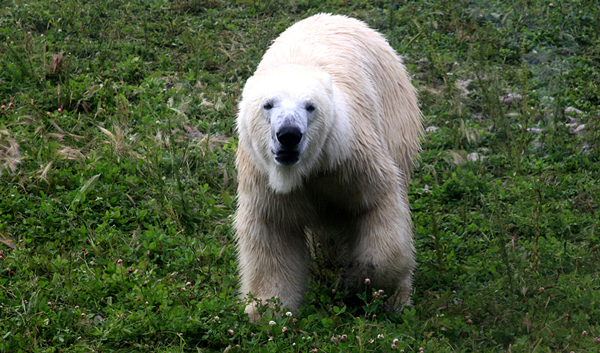
Photo: C. Grandpey
————————————————-
 Polar bears don’t usually show up in Southern or Western Greenland, but 2024 has been an exception. There are bears everywhere in West Greenland this year. Two of them recently appeared near Nuuk, Greenland’s capital. Quite a few have been way too close to towns in South Greenland this summer, too. Several polar bears have been shot in Qaqortoq, as the bears were literally in town. This is not a good sign. It means the animals are no longer finding enough food in the ocean. 68 polar bears showed up earlier this year in East Greenland to feast on the same whale carcass. Another reason for the unusual presence of polar bears in some parts of Greenland is that there is a lot of pack ice this year. It travels down East Greenland and around the southern tip of Greenland and then north again with the current. Hence the bears’ presence in Qaqortoq, Nuuq, and elsewhere.
Two polar bears even appeared on the popular 160km Arctic Circle Trail between Kangerlussuaq and Sisimiut. Because bears are rare in that part of the Arctic, hikers and locals don’t carry firearms. Several hikers have canceled their plans due to the potential bear threat. However, theu should be warned that calling for helicopter evacuation when you merely sight a polar bear is likely not covered by your insurance.
A German man participating in a research team was attacked by a polar bear in East Greenland on July 24th, 2024. The incident occurred on Traill Island near Mestersvig. Only one person was injured in the attack and was immediately airlifted to a hospital in Iceland. His condition has been reported stable. The polar bear responsible for the attack was shot following the incident.
In response to this high number of polar bears, the World Wildlife Fund (WWF) initiated their polar bear patrol earlier than scheduled. The patrol typically operates from mid-August to January, but this year started early due to several encounters in which polar bears approached humans too closely. Equipped with an ATV (all-terrain vehicle) and rubber bullets, the patrol aims to scare the bears away from towns to avoid tragic confrontations.
By the end of July, two polar bears were shot after moving alarmingly close to people ; one was heading toward a soccer field where children were playing, and the other was wandering around a residential area.
Source : US news media.
 Claude Grandpey : Volcans et Glaciers