 Situé à environ 482 km à l’ouest d’Astoria, dans l’Oregon, le volcan sous-marin Axial – Axial Seamount – est le plus jeune volcan et le principal centre éruptif actif de la chaîne Cobb-Eickelberg, une chaîne de volcans sous-marins qui se termine au sud de l’Alaska. L’Axial se trouve à l’endroit où la chaîne croise la dorsale Juan de Fuca. Sa présence est le fruit du point chaud de Cobb, mais il se trouve aussi sur une zone d’accrétion océanique entre la plaque Juan de Fuca et la plaque nord-américaine, comme on peut le voir sur la carte ci-dessous.
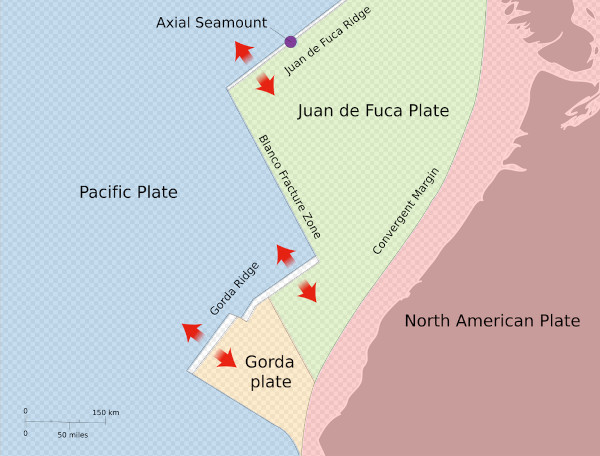
Carte Montrant la position de l’Axial sur la dorsale Juan de Fuca (Source : USGS)
L’Axial Seamount est le volcan le plus actif de la région nord-ouest du Pacifique. Depuis de nombreuses années, les chercheurs suivent attentivement son activité qui connaît un processus cyclique d’inflation et de déflation depuis sa dernière éruption en 2015, décrite dans ma note du 16 septembre 2015 :
https://claudegrandpeyvolcansetglaciers.com/2015/09/16/confirmation-de-leruption-de-laxial-seamount/
En mars 2024, le soulèvement du volcan sous-marin atteignait 90 – 95 % du niveau qui a précédé l’éruption de 2015 et se rapprochait du seuil susceptible de provoquer une nouvelle éruption. L’inflation, qui avait augmenté au moment de l’éruption de 2015, avait progressivement diminué jusqu’à ces derniers temps. Cependant, à partir d’octobre 2023, on a observé une augmentation significative du soulèvement au niveau de l’Axial, qui est actuellement estimé à 5 à 6 cm par an, signe d’un réveil potentiel du volcan. La hausse de l’inflation s’accompagne d’une augmentation de l’activité sismique avec de nombreuses secousses enregistrées récemment dans la région.

Source : NOAA
Les scientifiques affirment qu’une éruption pourrait se produire entre 2025 et 2026, mais admettent leur incapacité à prévoir un tel événement. Ils soulignent l’importance d’une surveillance et de recherches cohérentes pour améliorer la prévision des éruptions.
L’Axial Seamount présente la structure d’un volcan bouclier, semblable à ceux que l’on rencontre à Hawaï; elle contribue à son modèle éruptif distinct. Le comportement de l’Axial offre aux scientifiques des informations importantes sur les processus volcaniques sous-marins et les risques qui les accompagnent
Source : The Watchers.
————————————————–
 Located about 482 km west of Astoria, Oregon, Axial Seamount is the youngest volcano and current eruptive center of the Cobb–Eickelberg Seamount chain, a chain of seamounts that terminates south of Alaska. Axial lies where the chain intersects with the Juan de Fuca Ridge. It is a product of the Cobb hotspot, but now sits on an ocean spreading center between the Juan de Fuca Plate and the North American Plate (see map above).
Axial Seamount is the most active volcano in the Pacific Northwest region. For many years, researchers have been keenly observing the activity of the volcano which has been undergoing a cyclical process of inflation and deflation since its last eruption in 2015 that I described in a post of September 16th, 2015 :
https://claudegrandpeyvolcansetglaciers.com/2015/09/16/confirmation-de-leruption-de-laxial-seamount/
By March 2024, the seamount was 90 – 95% reinflated to its pre-eruption level and was getting close to a crucial threshold that might cause another eruption. The inflation rate which originally surged at the time of the 2015 eruption has progressively decreased until recently. However, from October 2023 there has been a noticeable increase in the pace of uplift, which is now estimated at 5 – 6 cm per year, indicating a potential awakening.The rise in inflation is accompanied by an increase in seismic activity with many earthquakes rocking the region recently (see chart above).
Although no real prediction is possible, local scientists say that an eruption might occur between 2025 and 2026, but they admit the unpredictability of volcanic activity, emphasizing the importance of consistent monitoring and research to improve eruption forecasting.
Axial Seamount’s shield volcano structure, similar to those found in Hawaii, contributes to its distinct eruptive pattern. This behaviour offers scientists important information about underwater volcanic processes and their possible hazards.
Source : The Watchers.
 Claude Grandpey : Volcans et Glaciers