
 Comme je l’ai écrit à plusieurs reprises, les glaciers – de l’Himalaya, en particulier – sont le château d’eau de l’Asie et leur fonte à cause du réchauffement climatique d’origine anthropique serait désastreuse pour des centaines de millions de personnes.
En Asie centrale, le Kirghizistan est l’un des pays sous la menace du réchauffement climatique. Bordé par le Kazakhstan, la Chine, le Tadjikistan et l’Ouzbékistan, il est plus loin de la mer que les autres pays et tous ses cours d’eau coulent dans des systèmes fermés qui n’atteignent pas la mer. La région montagneuse du Tian Shan couvre plus de 80 % du pays (le Kirghizistan est parfois appelé «la Suisse de l’Asie»), le reste étant constitué de vallées et de plaines. Les glaciers sont des sources cruciales d’eau douce et jouent un rôle important dans la sécurité alimentaire du Kirghizistan, car l’eau de fonte des glaces est utilisée pour l’irrigation et l’agriculture.
Le Kirghizistan a ouvert une enquête criminelle suite à la destruction d’un glacier par une entreprise privée. Cela montre les inquiétudes du pays face au risque de pénuries d’eau en Asie centrale. Les glaciers constituent une source vitale d’eau douce au Kirghizistan qui en héberge des milliers. Cependant, la hausse des températures due au réchauffement climatique et aux opérations minières les met en danger.
Une partie d’un glacier dans le sud de la région d’Osh a été détruite lorsqu’une entreprise privée a ouvert illégalement une route permettant l’accès à une mine de charbon dans la région, de toute évidence en collusion avec une entreprise publique. Suite à ces travaux entrepris dans la clandestinité, une superficie de 9 392 mètres carrés a été détruite. Une enquête pénale a été ouverte pour violation des règles de sécurité environnementale et « abus de position officielle ».
Source : AFP, Wikipedia.
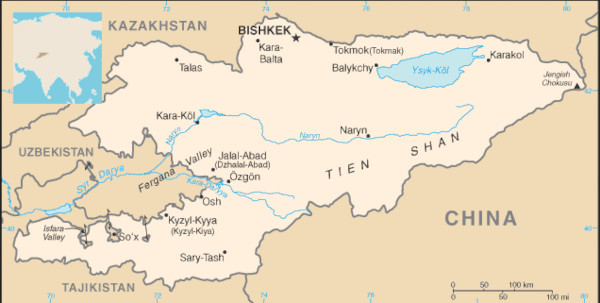
Source: Wikipedia
———————————————————–
 As I put it before, glaciers – especially in the Himalayas – are the water tower of Asia and their melting because of human-caused global warming would be a disastrous for hundreds of millions of people.
In Central Asia, Kyrgyzstan is one of these countries. Bordering Kazakhstan, China, Tajikistan and Uzbekistan, it is farther from the sea than any other individual country, and all its rivers flow into closed drainage systems which do not reach the sea. The mountainous region of the Tian Shan covers over 80% of the country (Kyrgyzstan is occasionally referred to as « the Switzerland) with the remainder made up of valleys and basins. Glaciers are crucial sources of freshwater and play an important role in Kyrgyzstan’s food security, as melting ice is used for irrigation and agriculture.
Kyrgyzstan has opened a criminal probe into the destruction of glacial ice by a private company, a move that shows the country’s concerns over water shortages in the Central Asian. Glaciers provide a vital source of freshwater in Kyrgyzstan which is home to thousands of them. However, rising temperatures due to global warming and mining operations are putting them at risk.
The glacial ice in the southern Osh region was destroyed when a private company illegally built a road to a coal mine in the area, allegedly in collusion with a state-owned firm. As a result of the illegal actions of the private company, glaciers and soil spanning an area of 9,392 square metres were destroyed. Prosecutors said they had opened a criminal case into environmental safety violations and the « abuse of an official position. »
Source : AFP, Wikipedia.
 Claude Grandpey : Volcans et Glaciers