
 L’Institut Árni Magnússon a choisi hraunkæling (« refroidissement de la lave ») comme mot de l’année 2024 en Islande. Le terme a pris de l’importance car cette technique islandaise vieille de 40 ans a été réutilisée pour protéger les infrastructures lors des dernières éruptions sur la péninsule de Reykjanes.
Chaque année, l’Institut examine dix mots de la langue islandaise, mais un seul est finalement choisi parmi tous ceux recueillis tout au long de l’année. Ces dernières années, les mots choisis ont souvent été liés à des événements marquants tels que la COVID-19, l’invasion russe de l’Ukraine, l’activité volcanique sur la péninsule de Reykjanes et l’essor de l’intelligence artificielle.
Cette année, aucun mot n’est ressorti statistiquement ou contextuellement. Les questions liées à l’immigration ont été largement abordées, quatre des dix mots nominés reflétant ce thème : inngilding (« inclusion »), búsetuúrræði (« solutions de logement »), móttökuskóli (« école d’accueil ») et fjölskyldusameining (« regroupement familial »). Outre les termes liés à l’immigration, la santé publique a été un autre thème important dans l’utilisation de l’islandais, avec des sujets allant des mesures préventives, comme éviter les aliments ultra-transformés (gjörunnin matvæli), aux traitements comme les médicaments contre l’obésité (þyngdarstjórnunarlyf).
Le mot de l’année 2024 a été inspiré par l’activité volcanique sur la péninsule de Reykjanes. Les six éruptions de 2024 ont suscité des efforts considérables pour protéger les infrastructures de la région. Parmi les nouveaux mots utilisés, on peut citer la réapparition de hraunkæling (refroidissement de la lave), une technique islandaise vieille de 40 ans, qui a été élue mot de l’année 2024.
Hraunkæling est un nom islandais composé qui combine hraun (qui signifie « lave ») et kæling (qui signifie « refroidissement »). C’est un nom féminin en islandais.
Selon l’Institut Árni Magnússon, ces dernières années, l’activité volcanique sur la péninsule de Reykjanes a dominé l’actualité, à commencer par l’éruption dans la Geldingadalur et à Fagradalsfjall, le 19 mars 2021. Au cours de cette année-là, les termes de volcanologie ont été nombreux dans la presse. Parmi les nominés possibles figuraient óróapúls (impulsion de tremor), gosmóða (brume volcanique) et kvikugangur (intrusion de magma).
Au cours des deux années suivantes, l’activité volcanique s’est poursuivie, mais aucun terme nouveau ou existant n’a vraiment retenu l’attention. En 2023, cependant, l’activité s’est intensifiée, avec six éruptions en un an. Divers termes sont apparus, tels que varnargarður (barrière protectrice), sprunguhreyfingar (mouvements de fissures) et kvikusöfnunarsvæði (zone d’accumulation de magma), mais hraunkæling a pris le plus d’importance.
Au cours de l’été 2024, le refroidissement de la lave a été utilisé car il n’était pas certain que les digues de terre à elles seules suffiraient à protéger les infrastructures. Cette technique, une innovation islandaise, s’était avérée efficace lors de l’éruption de 1973 sur Heimaey.
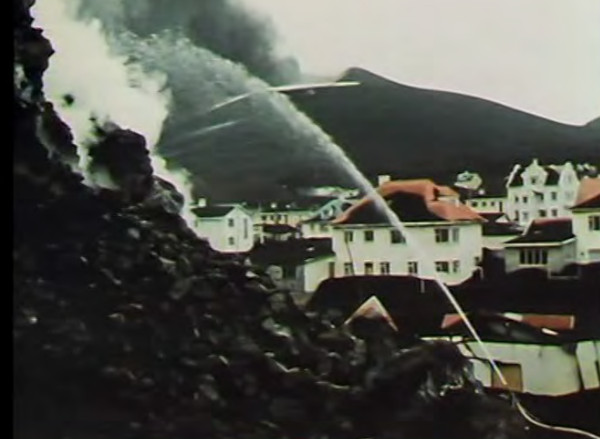
Refroidissement de la lave à Heimaey en 1973 (Source: Wiki Commons)
L’idée d’utiliser le refroidissement de la lave pour protéger les infrastructures de la péninsule de Reykjanes a été proposée pour la première fois en 2023. Le terme est apparu 161 fois dans le corpus islandais des gigamots (Risamálheild) cette année-là. Au cours des dix premiers mois de l’année 2024, il est apparu 1 530 fois.
Source : Iceland Review.

Refroidissement de la lave en 2024 (Source; Protection Civile)
————————————————
 The Árni Magnússon Institute has selected hraunkæling (“lava-cooling”) as its 2024 word of the year. The term gained prominence after a 40-year-old Icelandic technique was revived to protect infrastructure during recent eruptions on the Reykjanes peninsula.
Each year, the Institute considers ten words, but only one is chosen based on data collected throughout the year on language usage. In recent years, the words chosen have often been linked to significant events such as COVID-19, the Russian invasion of Ukraine, volcanic activity on the Reykjanes Peninsula, and the rise of artificial intelligence. This year, no single word stood out statistically or contextually as encapsulating the year’s defining features. Immigration-related issues were widely discussed, with four of the ten nominated words reflecting this theme: inngilding (‘inclusion’), búsetuúrræði (‘housing solutions’), móttökuskóli (‘reception school’), and fjölskyldusameining (‘family reunification’). In addition to immigration-related terms, public health was another prominent theme in language usage, with topics ranging from preventive measures, such as avoiding ultra-processed foods (gjörunnin matvæli), to treatments like weight management drugs (þyngdarstjórnunarlyf).
The 2024 word of the year was inspired by volcanic activity on the Reykjanes Peninsula. The six eruptions on the Reykjanes peninsula in 2024 have prompted extensive efforts to protect infrastructure in the area. These included reviving the word for a 40-year-old Icelandic technique to slow or stop lava flow ; hraunkæling (lava-cooling), which has been named the 2024 word of the year.
Hraunkæling is a compound Icelandic noun that combines hraun (meaning “lava”) and kæling (meaning “cooling”). It is a feminine noun in Icelandic.
According to the Árni Magnússon Institute, in recent years, volcanic activity on the Reykjanes Peninsula has been a defining feature, beginning with the eruption in Geldingadalur, Fagradalsfjall, on March 19, 2021. During that first year, terms from volcanology dominated. Notable nominees included óróapúls (tremor pulse), gosmóða (volcanic haze), and kvikugangur (magma intrusion).
In the two subsequent years, volcanic activity continued, but no new or existing terms gained significant attention. In 2023, however, saw a marked increase in activity, with six eruptions in one year. Various terms emerged, such as varnargarður (protective barrier), sprunguhreyfingar (fissure movements), and kvikusöfnunarsvæði (magma accumulation area), but hraunkæling gained the most prominence.
In the summer of 2024, lava cooling was employed when it was unclear whether protective barriers alone would suffice. This technique, an Icelandic innovation, had proven effective during the 1973 eruption on Heimaey. The idea of using lava cooling to protect infrastructure on the Reykjanes Peninsula was first proposed in 2023, with the term appearing 161 times in the Icelandic Gigaword Corpus (Risamálheild) that year. In the first ten months of the following year, 2024, it appeared 1,530 times.
Source : Iceland Review.
 Claude Grandpey : Volcans et Glaciers