
Réchauffement climatique : violent incendie en Patagonie // Global warming : violent wildfire in Patagonia

Depuis le 23 janvier 2024, un violent incendie de forêt ravage le Parc de Los Alerces, un site classé au patrimoine mondial de l’Unesco en Patagonie. La violence et l’ampleur de l’incendie sont dues au vent et à la sécheresse. En plein cœur de l’été austral, des températures records de plus de 40 °C frappent ces jours-ci la Patagonie argentine, région désertique de l’extrême sud du pays, habituellement froide et venteuse. Les feux se sont répandus à travers toute la région. Les autorités chiliennes ont ouverte une enquête et pensent que l’incendie aurait été causé par des visiteurs imprudents dans le parc

Alors que les pompiers essayaient de maîtriser le feu, il a fallu évacuer quatre cent touristes du Parc National. Les autorités locales ont confirmé que les feux ont détruit plus de 85 km² de végétation. L’incendie est situé dans la zone du ruisseau Centinela, près de la baie de Rosales.

Le président Sebastian Pinera à lancé un appel à l’aide d’urgence auprès de l’Argentine, l’Australie et les Etats-Unis après avoir déclaré la région zone sinistrée.

Des centaines de militaires et de pompiers ont été déployés sur les lieux pour lutter contre le feu. Les températures record en Patagonie argentine ont amené les provinces de Chubut et de Rio Negro à déclarer l’état d’urgence en raison du risque d’incendies jusqu’au mois d’avril.

On peut lire sur le site Internet de l’UNESCO que le Parc de Los Alerces couvre 188 379 hectares dans les Andes, au nord de la Patagonie, ses limites occidentales coïncidant avec la frontière chilienne. Les glaciations successives ont façonné le paysage de la région et créé des paysages spectaculaires faits notamment de moraines, de cirques glaciaires et de lacs aux eaux claires. La végétation est dominée par des forêts denses tempérées qui, en altitude, font place à des prairies alpines, sous les pics rocheux des Andes. La forêt de cyprès de Patagonie constitue un trait hautement caractéristique et emblématique de ce Parc. Menacé au plan mondial, le cyprès de Patagonie est la deuxième espèce d’arbre dont la longévité est la plus longue du monde (plus de 3 600 ans). Cette forêt abrite de nombreuses espèces de flore et de faune endémiques et menacées.

Source : presse internationale, UNESCO.
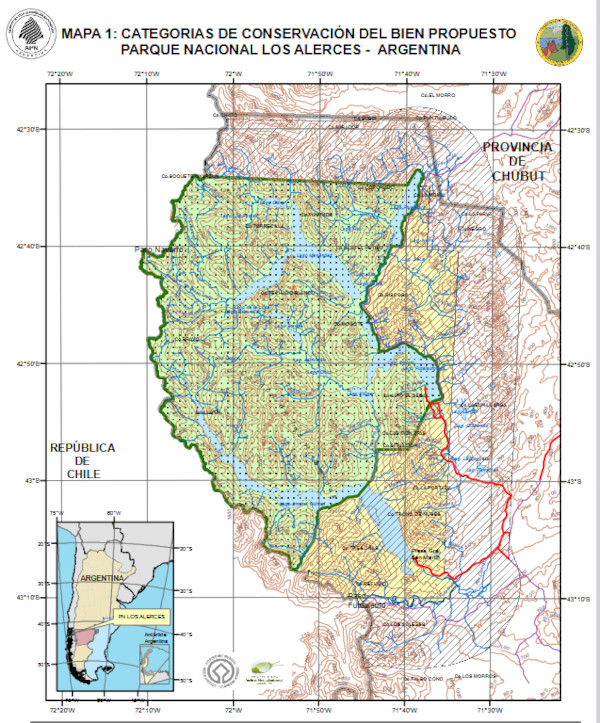
Source : UNESCO

Crédit photo : Service des parcs nationaux argentins

Il convient de noter que dans l’hémisphère nord, le 28 janvier 2024 a été le jour de janvier le plus chaud jamais enregistré au Royaume-Uni. Le village de Kinlochewe, en Écosse, a enregistré une température maximale de 19,6°C, et plusieurs secteurs du nord des Highlands ont également eu des températures au-dessus de 18°C.
Le précédent record pour une journée de janvier était de 18,3°C, enregistré quatre fois, la dernière fois le 16 janvier 2003.

——————————————————

Since January 23rd, 2024, a violent forest fire has ravaged Los Alerces Park, a UNESCO World Heritage site in Patagonia. The violence and scale of the fire are due to wind and drought. In the heart of the southern summer, record temperatures of more than 40°C have been recorded in Argentina’s Patagonia these days, a desert region in the far south of the country, usually cold and windy. The fires spread across the entire region. Chilean authorities have opened an investigation and believe the fire was caused by careless visitors to the park
While firefighters tried to bring the fire under control, 400 tourists had to be evacuated from the National Park. Local authorities confirmed that the fires destroyed more than 85 km² of vegetation. The fire is located in the Centinela Creek area near Rosales Bay.
President Sebastian Pinera appealed for emergency aid from Argentina, Australia and the United States after declaring the region a disaster zone.
Hundreds of soldiers and firefighters were deployed to the scene to fight the fire. Record temperatures in Argentine Patagonia have led the provinces of Chubut and Rio Negro to declare a state of emergency due to the risk of fires until April.
We can read on the UNESCO website that the Los Alerces Park covers 188,379 hectares in the Andes, in the north of Patagonia, its western limits coinciding with the Chilean border. Successive glaciations have shaped the landscape of the region and created spectacular landscapes including moraines, glacial cirques and clear water lakes. The vegetation is dominated by dense temperate forests which, at altitude, give way to alpine meadows, under the rocky peaks of the Andes. The Patagonian cypress forest constitutes a highly characteristic and emblematic feature of this Park. Threatened globally, the Patagonian cypress is the second longest-lived tree species in the world (more than 3,600 years). This forest is home to many endemic and endangered species of flora and fauna.
Source: international news media, UNESCO.

It should be noted that in the northern hemisphere January 28th, 2024 has been the hottest January day ever recorded in the UK. The village of Kinlochewe, Scotland, recorded a high of 19.6°C, with various neighbouring areas in the northernmost regions of the Highlands also in excess of 18°C.

The previous record for a January day was 18.3°C, which had occurred four times, most recently on January 16th, 2003.

Le noyau interne de la Terre oscille tous les 8,5 ans // Earth’s inner core exhibits an 8.5-year wobble

Des chercheurs chinois viennent de découvrir que tous les 8,5 ans, le noyau interne de notre planète oscille autour de son axe de rotation, ce qui pourrait remettre en question le modèle géophysique admis jusqu’à présent. Durant cette oscillation, l’axe s’inclinerait jusqu’à 0,17 degré par rapport à celui du manteau. Cela pourrait induire d’importants changements dans la dynamique interne de la Terre, tels que des variations du champ magnétique.

On sait depuis longtemps que la Terre comporte 4 couches : la croûte, le manteau, le noyau externe (liquide) et le noyau interne (solide). Ces derniers se trouvent à environ 2896 kilomètres sous la surface. Avec un rayon d’environ 1200 kilomètres, le noyau interne (principalement composé de fer et de nickel) joue un rôle essentiel dans les processus géophysiques de la planète, tels que le maintien du champ magnétique et de la rotation.

Selon le modèle géophysique admis jusqu’à maintenant, l’axe de rotation du noyau terrestre s’aligne avec celui du manteau. Cela implique une distribution de densité uniforme au niveau des deux structures. Cependant, les chercheurs de la nouvelle étude* ont détecté des signaux de déviation périodiques de l’axe de rotation du noyau interne, qui se produiraient tous les 8,5 ans.

Ces signaux d’oscillation du noyau interne avaient été mis au jour dans le cadre d’une précédente étude, lorsque les mêmes chercheurs avaient collecté des mesures sur plusieurs décennies du mouvement polaire de l’axe de rotation de la Terre et des changements de sa vitesse de rotation. La nouvelle étude*, parue dans la revue Nature Communications, visait à confirmer ces observations, pouvant potentiellement mener à un changement de paradigme dans notre compréhension de la dynamique géophysique terrestre.

Afin d’étayer leurs précédentes observations, les chercheurs chinois ont effectué des mesures des subtiles variations de la durée du jour dans plusieurs régions du monde. Ces variations sont en effet les principaux indicateurs des changements de l’inclinaison de l’axe de rotation de la Terre. Les mesures ont ensuite été comparées avec celles effectuées pour les mouvements polaires. Les calculs montrent que l’oscillation périodique du noyau interne est provoquée par une inclinaison de 0,17 degré de son axe de rotation, par rapport à celui du manteau.

Ces résultats sont en contradiction avec la théorie géophysique conventionnelle qui fait ressortir non seulement un alignement entre les axes de rotation du manteau et du noyau, mais également une forme parfaitement sphérique de ce dernier. L’inclinaison dont fait état la nouvelle étude serait susceptible de modifier la forme et le mouvement du noyau liquide, entraînant potentiellement des changements du champ magnétique terrestre. En outre, cela pourrait également entraîner une différence de densité de l’ordre de 0,52 g/cm3 au niveau de la zone séparant le noyau externe du noyau interne. Le pôle nord-ouest du noyau interne serait aussi un peu plus dense que le reste de la structure.

La dernière étude montre que l’oscillation du noyau interne induite par l’inclinaison de son axe pourrait avoir d’importantes implications dans l’ensemble de la dynamique interne de la Terre. Toutefois, ces observations ont été obtenues en excluant d’autres sources potentielles de variations qui pourraient influencer le mouvement polaire. En particulier, elles ne prennent pas en compte les paramètres atmosphériques, océaniques et hydrologiques. Néanmoins, cette découverte contribue à améliorer significativement la compréhension de la dynamique interne de la planète.

* Inner core static tilt inferred from intradecadal oscillation in the Earth’s rotation – An, Y., Ding, H., Chen, Z. et al. -Nat Commun 14, 8130 (2023). https://doi.org/10.1038/s41467-023-43894-9 – OPEN ACCESS

Source : presse scientifique internationale.

Schéma représentant l’oscillation du noyau interne autour de son axe de rotation (Source : Yachong An et al. )

—————————————————

Chinese researchers have just discovered that every 8.5 years, the inner core of our planet wobbles (or oscillates) around its axis of rotation, which could call into question the geophysical model accepted until now. During this oscillation, the axis would tilt up to 0.17 degrees relative to that of the mantle. This could induce important changes in the internal dynamics of the Earth, such as variations in the magnetic field.
It has long been known that the Earth has 4 layers: the crust, the mantle, the outer core (liquid) and the inner core (solid). These are located approximately 2,896 kilometers below the surface. With a radius of approximately 1,200 kilometers, the inner core (mainly composed of iron and nickel) plays an essential role in the planet’s geophysical processes, such as maintaining the magnetic field and rotation.
According to the geophysical model accepted until now, the axis of rotation of the Earth’s core aligns with that of the mantle. This implies a uniform density distribution at both structures. However, the researchers in the new study* detected periodic deviation signals from the axis of rotation of the inner core, which would occur every 8.5 years.
These inner core oscillation signals were uncovered in a previous study, when the same researchers collected measurements over several decades of the polar motion of the Earth’s axis of rotation and changes in its rotation speed. The new study*, published in the journal Nature Communications, aimed to confirm these observations, potentially leading to a paradigm shift in our understanding of Earth’s geophysical dynamics.
To support their previous observations, Chinese researchers took measurements of subtle variations in day length in several regions of the world. These variations are in fact the main indicators of changes in the inclination of the Earth’s axis of rotation. The measurements were then compared with those made for polar movements. Calculations show that the periodic oscillation of the inner core is caused by a 0.17 degree inclination of its axis of rotation, relative to that of the mantle.
These results are in contradiction with conventional geophysical theory which highlights not only an alignment between the axes of rotation of the mantle and the core, but also a perfectly spherical shape of the latter. The tilt reported in the new study could modify the shape and movement of the liquid core, potentially leading to changes in the Earth’s magnetic field. In addition, this could also lead to a difference in density of the order of 0.52 g/cm3 in the area separating the outer core from the inner core. The northwest pole of the inner core would also be a little denser than the rest of the structure.
The latest study shows that the oscillation of the inner core induced by the tilt of its axis could have important implications for the entire internal dynamics of the Earth. However, these observations were obtained while excluding other potential sources of variations that could influence polar motion. In particular, they do not take into account atmospheric, oceanic and hydrological parameters. Nevertheless, this discovery contributes to significantly improving the understanding of the internal dynamics of the planet.

* Inner core static tilt inferred from intracadal oscillation in the Earth’s rotation – An, Y., Ding, H., Chen, Z. et al. -Nat Commun 14, 8130 (2023). https://doi.org/10.1038/s41467-023-43894-9 – OPEN ACCESS

Source: international scientific press.