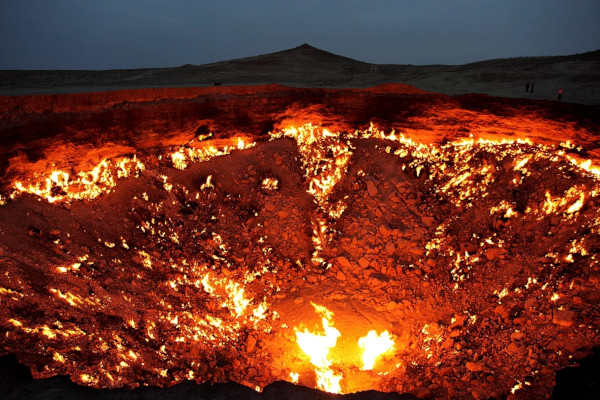
 On pourrait penser qu’il s’agit d’un cratère volcanique, mais ce n’en est pas un. Le site, baptisé « Portes de l’Enfer », se trouve près de Darvaza, au Turkménistan, à environ 260 kilomètres au nord de la capitale, Achgabat. Ce gisement de gaz naturel brûle sans interruption depuis des décennies grâce à l’infiltration constante de méthane. De ce fait,il est devenu l’une des attractions touristiques les plus populaires du pays, malgré sa situation au cœur du désert du Karakoum.
Dans une note publiée le 9 janvier 2022, j’expliquais que le président du Turkménistan avait demandé de mettre terme au feu dans le cratère. Il avait ordonné à son gouvernement de chercher des moyens de l’éteindre car le site cause des dégâts à l’environnement et affecte la santé des personnes qui vivent dans la région.
Aujourd’hui, un nouveau rapport nous apprend que la situation pourrait évoluer dans ce sens. Le 6 juin 2025, des responsables turkmènes ont déclaré que les émissions de gaz étaient trois fois moins importantes, bien que l’Agence France-Presse (AFP) précise qu’aucun détail n’a été fourni pour justifier cette diminution. Cette information concorde avec des rapports publiés en 2024, selon lesquels les observations satellites des Portes de l’Enfer montraient une baisse de 50 % des émissions.
Personne ne sait vraiment comment s’est formé le cratère en feu. L’histoire populaire raconte que des prospecteurs soviétiques auraient accidentellement fait s’effondrer une mine dans les années 1960, puis auraient mis le feu au gaz. Toutefois, la presse locale affirme que l’incendie a en réalité été déclenché dans les années 1980 pour empêcher le gaz nocif de s’échapper. Selon un article du National Geographic en 2013, il n’existe aucune trace ni aucun rapport sur la formation initiale du gisement de gaz.
Bien que le puits en feu soit une attraction touristique, l’arrêt de son activité serait probablement la meilleure solution pour de nombreuses raisons. Le gaz émis est du méthane ; il a un impact sur la population locale et contribue au réchauffement climatique, c’est un gaz à effet de serre extrêmement puissant, encore plus destructeur que le dioxyde de carbone.
Comme indiqué plus haut, la fermeture du cratère est un sujet d’actualité depuis au moins 15 ans. Son comblement avait été envisagé, mais la plupart des experts estimaient que le gaz s’échapperait probablement ailleurs. Cependant, ces dernières années, il semble que le gouvernement ait évolué dans son approche du problème. En 2024, des puits d’exploration ont été forés près du cratère. L’objectif était, semble-t-il, d’extraire le méthane du puits et de l’exploiter à d’autres fins, mais ces informations ne sont que des rumeurs.
Alors que les flammes à l’intérieur du cratère de gaz de Darvaza s’éteignent lentement, certains habitants s’inquiètent des pertes financières, liées au tourisme, qu’occasionnerait la disparition des Portes de l’Enfer..
Source : Popular Machanics.
Crédit photo: Wikipedia
———————————————-
 It might look like a volcanic crater but it is not. The site named « Gates of Hell » lies near Darvaza, Turkmenistan. It is located about 260 kilometers north of the capital, Ashgabat. This natural gas field has been burning continuously for decades thanks to its steady infiltration of methane, and as such, this burning pit has become one of the country’s most popular tourist attractions despite its location in the middle of the Karakum desert.
In a post published on 9 January 2022, I explained that the president of Turkmenistan had called for an end to the blazing crater. He had ordered his government to look for ways to put the fire out because it was causing ecological damage and affecting the health of people living in the area.
Today, a new report suggests those efforts may be bearing fruit. On June 6th, 2025, officials in Turkmenistan said that gas being emitted from the pit had diminished three-fold, though the Agence France-Presse (AFP) reports that no timeframe for this gaseous decrease was provided. This news is in line with previous reports released in 2024 that satellite observations of the Gates of Hell showed a 50 percent decline in emissions.
There is some debate about how the gas crater initially formed. The popular story goes that Soviet prospectors accidentally collapsed a mine in the 1960s and then lit the gas on fire, but local reporting says that the fire was actually started in the 1980s to prevent the harmful gas from escaping. As National Geographic article indicated in 2013, there were no records or reports of the gas field’s initial formation.
Although the pit is a tourist attraction, closing it off is likely for the best for many reasons. The harmful gas impacts the local population and contributes to global warming as the emitted gas is methane, an extremely potent greenhouse gas, even more destructive than carbon dioxide.
The closure of the gas crater for has been a topic for at least 15 years. Filling the pit had been considered an option, but most experts said that the gas would likely just escape somewhere else. However, in the last few years, it appears that the government has made some progress. In 2024, exploratory wells were drilled near the crater. It was said that the aim was both to draw away the pit’s methane and to leverage the natural resource for other purposes, but these reports are only rumors.
As the flames of the Darvaza gas crater slowly flicker out, some locals are concerned about the loss of money from tourism.
Source : Popular Machanics.
 Claude Grandpey : Volcans et Glaciers