 Comme je l’ai écrit dans une note précédente, Yellowstone a été secoué par un essaim sismique qui a fait suite à une longue période de calme dans le Parc.
Le Professeur Robert B. Smith, géophysicien à l’Université de l’Utah et l’un des plus grands spécialistes en matière d’activité tectonique et volcanique à Yellowstone, a donné quelques explications sur cet événement. L’essaim sismique s’est produit à 16 km au NO du Vieux Fidèle et à 15 km au SE de West Yellowstone. Il a eu lieu dans une zone située à 8 km de l’endroit où l’on a enregistré l’essaim d’Octobre1985, le plus important jamais observé dans le Parc.
Selon le Professeur Smith, de tels essaims sont « relativement fréquents ». Les dernières secousses semblent être liées à une activité tectonique normale et « ne sont pas une indication d’une prochaine activité volcanique ».
Depuis 1995, on a enregistré 80 essaims sismiques, y compris celui qui a commencé dimanche dernier. Il faut remarquer qu’il n’y a pas le moindre lien entre ce qui se passe à Yellowstone et le séisme de M 7 qui a ravagé Haïti.
Fin décembre 2008 et début janvier 2009, Yellowstone a connu le deuxième plus grand essaim sismique de l’histoire du parc, avec 813 séismes d’une magnitude allant jusqu’à 3,9.
Le séisme le plus dévastateur a eu lieu le 17 août 1959 quand un événement de M 7,3 a tué 28 personnes et causé plus de 11 millions de dollars de dégâts.
Source : The Denver post. .
 As I put it in a previous note, Yellowstone National Park has been shaken by a seismic swarm that followed a period of 11 months of quiet seismic activity in the park.
Professor Robert B. Smith, a geophysicist at the University of Utah and one of the leading experts on earthquake and volcanic activity at Yellowstone, has given a few explanations about the event. The swarm was located about 16 km northwest of Old Faithful and 15 km southeast of West Yellowstone. It occurred in an area about 8 km from where the largest swarm of quakes was ever recorded in October 1985.
According to Prof. Smith, such swarms are « relatively common. » Today’s tremors seem to be normal tectonic activity, and is « not an indication that some sort of volcanic activity will occur”.
Since 1995 there have been 80 swarms, including the one that started Sunday. It should be noted that there is absolutely no connection between what is occurring in Yellowstone and the magnitude 7.0 earthquake in Haiti.
In late December 2008 and early January 2009, Yellowstone National Park experienced the second largest earthquake swarm in Yellowstone. It consisted of 813 earthquakes with magnitudes ranging up to 3.9.
The most devastating earthquake in recent history in the Yellowstone region occurred on August 17th, 1959, with a M 7.3 earthquake that killed 28 people and caused more than $11 million in damage.
Source: The Denver Post.
Grand Prismatic Spring, l’une des plus belles sources du Parc.
(Photo: C. Grandpey)
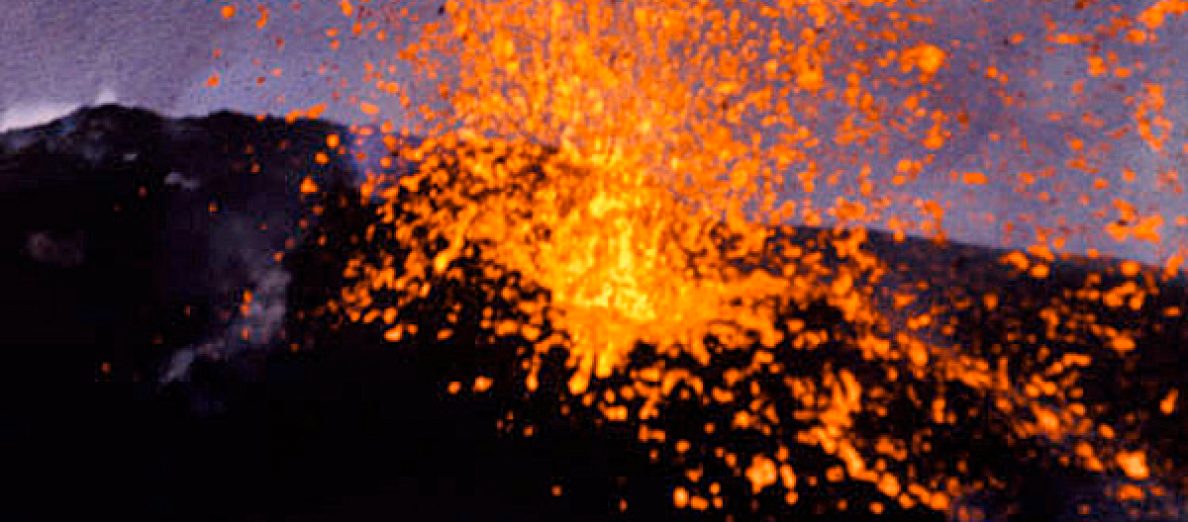
 Le volcan est actuellement dans la phase descendante d’un événement de Dégonflement / Gonflement. L’alimentation est donc réduite. Le niveau de la lave a baissé dans la bouche de l’Halema’uma’u. La lave avait commencé à descendre du TEB sur l’East Rift Zone pour se diriger vers la mer. Le front des coulées était à environ 400 mètres d’altitude sur le pali où de petits incendies avaient été observés dans la végétation des Royal Gardens. Il est probable que la lave sera fortement ralentie dans sa progression et n’atteindra donc pas le rivage dans les prochains jours. Une lueur est visible de temps à autre dans le Pu’uO’o.
 The volcano is currently going through the Deflation phase of a D/I event and is then poorly fed. Lava level has gone down at the bottom of the Halema’uma’u vent. Lava had started travelling down from the TEB in the East Rift Zone towards the sea. The front was about 400 metres a.s.l. on the pali where it was burning vegetation in the Royal gardens. It is likely that lava will slow down and will not reach the shore in the next few days. Glow can occasionally be seen in Pu’uO’o.

 Bien que plus discret que par le passé, le volcan reste bien actif. Ainsi, pendant la deuxième quinzaine de décembre, les panaches de gaz et de vapeur montaient jusqu’à 1,5 km au-dessus des dômes de lave qui se sont formés au sommet. La sismicité indiquait que les dômes continuaient à croître. Le 6 janvier, les images satellites montraient un panache s’étirant sur 50 km vers l’ENE à une altitude de 2,1 km.
 Although it is more discreet than in the past, the volcano is still quite active. During the second half of December, steam-and-gas plumes rose 1.5 km above the lava domes. Seismicity indicated that the domes continued to grow. On January 6th,
