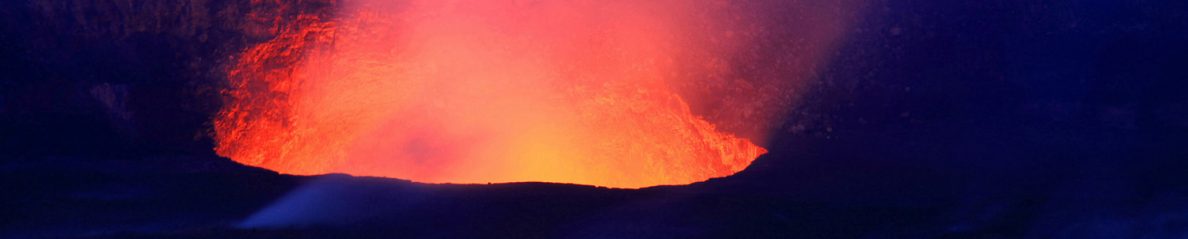
 7 heures: Le 8 avril au matin, une nouvelle phase d’activité a débuté dans le pit cratère qui perce le versant E du Cratère SE.
Au cours de la journée du 8 avril, l’activité est restée relativement faible et s’est limitée à des explosions stromboliennes à partir de deux bouches dans la partie ouest du cratère.
Le 9 avril au matin, on a observé une intensification de l’activité sismique et de l’activité strombolienne. En fin d’après-midi, les premiers blocs incandescents ont fait leur apparition dans la brèche qui entaille la lèvre orientale du cratère et, vers 18 heures (GMT) une coulée s’est dirigée vers la paroi ouest de la Valle del Bove où elle a parcouru environ un kilomètre. Dans le même temps, une petite activité strombolienne persistait dans le cratère.
Au vu du tremor et des sismos en ligne, l’activité semble se poursuivre ce matin.
Source: INGV.
13h30: L’Etna connaît une montée en pression depuis la mi-journée et au moment où j’écris ces lignes, un bel épisode de fontaine de lave affecte le Cratère SE. Malheureusement, la visibilité très moyenne gâche quelque peu le spectacle. Les nuages de vapeur qui s’élèvent en aval du cratère indiquent probablement qu’une coulée de lave est entrée en contact avec la neige dans sa progression vers la Valle del Bove.
16 heures: Le paroxysme éruptif de l’Etna est maintenant terminé. La sismicité et le tremor sont revenus à des valeurs basses. Les fontaines et coulées de lave ont pris fin vers 13h20 (GMT). Cet épisode éruptif ressemble aux précédents. Il se confirme que le Cratère SE joue depuis plusieurs mois le rôle de soupape du volcan. Cet événement confirme également qu’il existe bel et bien un lien entre le Cratère SE et le Cratère NE. En effet, ce n’est pas la première fois que l’on observe (je cite l’INGV) « un déplacement du tremor du Cratère NE vers le Cratère SE ».
 7:00: Since the morning of April 8th, a new phase of eruptive activity has been under way at the pit crater on the eastern flank of the Southeast Crater cone.
Throughout the day of April 8th, the eruptive activity showed low levels of intensity, and was characterized by small Strombolian explosions that occurred from two vents located in the western portion of the crater floor
During the morning of April 9th, the seismic network recorded a slight increase in the seismic activity produced by the Strombolian activity, which gradually grew in intensity
At sunset, the first blocks of incandescent lava appeared within the breach in the eastern rim of the crater, heralding a small overflow of lava shortly before 18:00 GMT. The lava slowly advanced from the base of the Southeast Crater cone toward the western headwall of the Valle del Bove
On the late evening, the lava flow continued to be fed, and had reached a length of about 1 km; at the same time frequent but small Strombolian explosions continued within the crater, which rarely threw incandescent ejecta beyond the crater rim
Judging from the tremor and the seismograms, this kind of activity seems to be going on this morning.
Source : INGV.
13:30: Mount Etna has been more and more active since the middle of the day and an episode of lava fountaining can currently be seen at the SE Crater. Unfortunately, visibility is not very good, which slightly spoils the show. The steam clouds rising below the crater probably indicate that a lava flow has come into contact with the snow on its way down the Valle del Bove.
16:00: The eruption is now over. Seismicity and the tremor have gone back to low values. Lava fountains and flows stopped at 13:20 or so (GMT). This eruptive event looked like the previous one. It confirms that the SE Crater has become for several months a kind of valve through which the volcano releases its energy. It also shows there exists a link between the NE Crater and the SE Crater; indeed, this is not the first time the source of the tremor has shifted from its previous position below the Northeast Crater toward the active vent.

 Le PHILVOCS vient d’élever à 2 (sur une échelle de 5) le niveau d’alerte du Taal. En effet, les dernières observations ont révélé une augmentation de la sismicité qui semble être plus superficielle. 21 séismes ont été enregistrés au cours des dernières 24 heures, entre 1 et 4 kilomètres de la surface. Certains se situent directement sous Volcano Island, dans le lac qui occupe la caldeira.
 PHILVOCS has just raised the alert level to 2 (on a scale of 5) and warned of the potential of an eruption. The latest observations revealed an increase in seismicity that appears to also be getting shallower, with 21 earthquakes in the last 24 hours, all within 1-4 km of the surface Some are located directly under Volcanic Island in the Taal caldera lake.
 Claude Grandpey : Volcans et Glaciers